

So you think you know your Michigan political history?
Well, let’s see how you do with this presidential pop quiz.
1. Who is the only Democratic presidential nominee buried within Detroit’s city limits?
2. Which presidential nominee was born in Michigan, wrote for The Michigan Daily, and almost became an opera singer?
3. Name the father-son duo, each of whom wanted to be president and neither of whom came close to the nomination.
4. Name the commander in chief with Michigan ties who was never eleted president. Or vice president. Or governor. Or Senator.
* If you’re certain you aced the test, you can stop reading here. Otherwise, we’ll let you in on the answers gradually (unless you need to collect on a bet; in that case, skip to the answers at the end of the story.
So, the presidential election is next month and, once again, Michigan doesn’t have an entry in the main event. Detroit native Mitt Romney, who a year ago was a leading contender for the Republican nomination, folded his tent before Valentine’s Day.
That keeps our national record for electing those from Michigan to the presidency intact: at precisely zero.
Ohio, which has only slightly more people than Michigan, has produced seven presidents. Virginia, which has considerably fewer, has sent eight men to the White House.
Michigan can claim only Gerald Rudolph Ford, who, as a matter of fact, wasn’t originally from Michigan and wasn’t initially named Ford. He was born Leslie Lynch King Jr. in Omaha, Neb. (His parents divorced, and his name was later changed to that of his stepfather.)
And, as another matter of fact, Michigan’s only president never wanted to be president. Nor was he ever elected president or vice president.
He never got the one job he really wanted: speaker of the house. He became president only because of a chain of the most bizarre circumstances in our nation’s history.
Then, when he finally decided he liked the big job and asked the voters to give him four years in his own right, they tossed him out.
Clearly, Michigan gets no respect. Even tiny Vermont has sent two men (Calvin Coolidge and Chester A. Arthur) to the White House. These days, we’re lucky if we can even get the current president to meet with the CEOs of the not-so-big-anymore three.
But it could have been different. Four times, major parties have nominated men from Michigan for the office of president of the United States. Naturally, the two everyone thought were from Michigan were actually born elsewhere.
The one who was born and bred in Michigan actually is best remembered as the governor of New York. Two of Michigan’s nominees were favored to win, and lost decisively to underdogs. One of them was sort of the George Washington of our state; another helped save our nation from a national nightmare.
But they all had this in common: Whenever they tossed their hats in the ring, went for the gold, and tried to be the man, American voters slammed the door. So who were our men-who-could-have-been? Here’s a brief look:
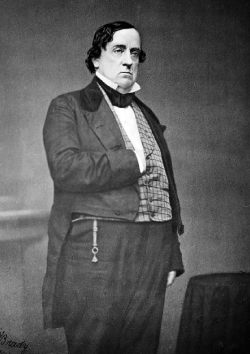
Lewis Cass
Today, few of us know that before his name became that of an infamous urban corridor, Cass (1782-1866) was actually a real person who became the father of our state. He’s also the reason we’re called Michiganders.
Born in New Hampshire to a fighting blacksmith at the tail end of the American Revolution, Cass was a hero of the War of 1812, especially in the fighting around Detroit. He was rewarded by being made governor of Michigan Territory, back when it really was the Wild West. He fought Native Americans until he won their trust.
A staunch Jeffersonian Democrat, Cass gave the state a law code, a judicial system, and later was secretary of war, minister to France, and, after Michigan became a state, a U.S. senator.
He also attracted the attention of an unknown first-term congressman from Illinois, a backwoods guy with a wicked sense of humor who noticed that Cass had gotten so fat that he waddled. Abraham Lincoln sarcastically called him “the great Michigander.”
The name stuck, and, especially after Lincoln achieved modest fame, it began to be applied to all Michigan residents. At the time (1848), however, Cass was far more famous than Lincoln, and easily won the Democratic presidential nomination that summer.
He ought to have won easily. But the party split over slavery. Cass tried to steer a middle course, which turned out to be disastrous. Former President Martin Van Buren, the H. Ross Perot of his day, ran on a third-party ticket and split the Democrats.
That handed the election to Zachary Taylor, a not-very-bright general who had won a couple of key victories in the Mexican War.
Old Lewis sucked it up, stayed in the Senate, and went on to serve with distinction as secretary of state, quitting on principle when President James Buchanan refused to try to stop the South from seceding. He went back to Detroit and helped raise troops for the Civil War, earning Lincoln’s respect and gratitude.
He outlived Lincoln, dying a year after the war was over, and is buried in Elmwood Cemetery just east of downtown — a cemetery he had helped found, as he did so much else.
Thomas E. Dewey
Thomas Dewey holds a number of unique distinctions in the history of presidential politics. Mostly he is remembered for being on the wrong end of the biggest upset in political history, as in the infamously wrong Chicago Tribune headline, DEWEY DE- FEATS TRUMAN.
But Dewey was also the most politically famous son of Michigan. Trouble was, almost nobody knew he was from the Great Lakes State. He was also the youngest man ever to be nominated by the Republicans, and managed to have careers as a singer, an anti-mob prosecutor, a three-term governor, and a washed-up, two-time presidential election loser — all before he was 47 years old. In 1948, he managed to lose a race that everyone thought he would win, in large part by boring everyone to death.
But he seemed to stay a cheerful good sport about it. He grew up in Owosso and went to the University of Michigan, where he spent a lot of time, not in student government, but working on The Michigan Daily and singing.
He won a statewide singing contest (he liked opera, and was a baritone) and nearly tried for an operatic career.
But he worried what would happen if his vocal cords went out on him, and so he went off to Columbia to study law. Some accounts say he really did so in the hopes of getting to the Metropolitan Opera.
However, his most recent biographer, Richard Norton Smith, said Dewey found Ann Arbor stone boring. His legal career took off fast, and he became known as the fighting district attorney who put away mobsters Lucky Luciano and Waxey Gordon. That led to the GOP presidential nomination in 1944. Nobody really expected him to beat Franklin D. Roosevelt during a world war, and he didn’t. But he made a good enough showing to merit another try four years later.
Nobody thought Dewey would have any problem beating Harry Truman. So he ran the most safely boring campaign imaginable. The delightfully nasty Alice Roosevelt Longworth said he looked like “the little man on the wedding cake.” And he did — exactly. Maybe partly as a result of that, he lost again, though he did carry Michigan. Dewey was gracious, and went on to become sort of a young elder statesman of the moderate wing of the GOP, dying of a sudden heart attack in 1971.
If he ever sneaked back to Owosso, history does not record it.
The Romneys
Gov. George Romney seemed a shoo-in for the Republican nomination in 1968, until he told local TV interviewer Lou Gordon that he “just had the greatest brainwashing” by the generals in Vietnam. “I would have thought a light rinse would have done it,” quipped Democratic candidate Eugene McCarthy.
Oops. Ouch. Game over.
Forty years later, in 2008, his son Mitt gave it a whirl. Like his father, he was 60 when he ran. They were very much alike. Except that, unlike his father, Mitt was born in Michigan. And while the elder Romney lived in and was governor of Michigan, Mitt lived in and had been governor of Massachusetts. Nobody ever said Mitt had been brainwashed. On the other hand, nobody ever said they were sure what he stood for.
Oops. Ouch. Game over.
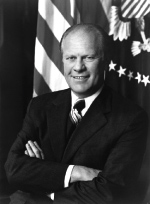
Gerald R. Ford
Long after he left the White House, President Gerald Ford said in an interview (with this writer) that he knew he probably would lose the 1976 election when he pardoned Richard Nixon. He was right. Today, most historians and even onetime foes such as U.S. Sen. Edward Kennedy agree that the pardon was the right thing to do.
His road to the presidency was the oddest in American history. When Vice President Spiro Agnew turned out to be a crook, Nixon tapped Ford — then the well-liked House minority leader — to be vice president.
When Nixon turned out to be a liar and a crook and had to resign, Ford became president. His administration is remembered for the Nixon pardon, the end of the Vietnam War, and those silly “Whip Inflation Now” buttons. (Bonus question: Whom did Ford appoint as his vice president? See below.)
When President Jimmy Carter was sworn in, the first thing he did was thank President Ford “for all you have done to heal this land.”
Well, those guys are the closest our state has ever come to actually electing a president. And it doesn’t seem likely that any of our current politicians are apt to run anytime soon.
Gov. Jennifer Granholm was born a Canadian and so is not eligible. U.S. Sen. Carl Levin is too old. U.S. Sen. Debbie Stabenow doesn’t have the clout. There are no “mentionable” Republicans (unless Mitt Romney gets another bite at the apple).
But don’t lose hope. This doesn’t mean we’ll never have a president who can find Eight Mile Road. It just means we may have to wait until it has been resurfaced — a few more times.
Quiz Answers
|
|
|