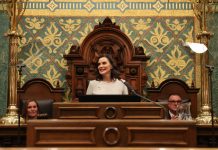
Pete Buttigieg, former Secretary of Transportation under President Joe Biden, spoke to a group of media and automotive industry professionals at the opening day of the Detroit Auto Show. In a fireside chat with MSU President Kevin M. Guskiewicz, Buttigieg, who lives outside of Traverse City, discussed a variety of topics related to the future of EV technology and policymaking, as well as the state of U.S. infrastructure at the Mobility Global Forum.
Who Controls the Future of EV?
The opening of the Auto Show came one day after President Donald Trump visited metro Detroit. During his visit, he toured a Ford truck plant and spoke with the Detroit Economic Club. One key point Trump made during his speech was his support of internal combustion engines and his disapproval of Biden-based EV strategy. Buttigieg, however, believes EV is the future of automotive, and the U.S. should embrace its potential.
“We are living in the most transformational moment for transportation since the combustion engine was developed,” Buttigieg said. “The question is, what are we going to do with it?”
Buttigieg pointed to China’s dominance in the EV world, where they account for 70% of global EV manufacturing as of 2024, as motivation for greater U.S. involvement.
“There is no question about whether this technology will be the future of the sector. There is a big question about whether America will lead that,” Buttigieg stated. “We can own the 21st Century just as much as we did the 20th, but it won’t happen on itself.”
In Buttigieg’s opinion, automotive industry leaders should take a more active role in securing this future.
In the Q&A portion of the chat, Hour Detroit asked Buttigieg how he feels automative leaders could more effectively work with the current administration. “I would love to see industry pushing the president instead of the other way around,” he answered. “I think industry can and should, especially if it sticks together. The president cannot stop electric vehicles from advancing to become the leading automotive technology, but he can stop America from being the leader in that technology industry.”
Autonomous Driving is Changing the Game
The role of automation continues to expand. However, one area that people are often reluctant about its use in is driving. But Buttigieg believes this fear is misplaced, and that autonomous driving can usher in a safer wave of transportation.
“We have now very clearly reached the point where a typical automated vehicle that’s on the road today is safer than you or I behind the wheel,” Buttigieg said.
So far, the data seems to back this up, with a report showing that self-driving cars are involved in 80% fewer crashes than human operated vehicles. Buttigieg also thinks they have the potential to change the way people view car ownership.
“The future is not going to be cars that look like the cars that we know,” Buttigieg said. “Not only are they physically going to be different, but the ownership proposition is going to be different. I would anticipate a lot of two car households becoming one car households.”
Policymakers, Industry Leaders, and Higher Education
Known as the triple helix model of innovation, the interplay between universities, government, and industry is crucial. Buttigieg points to the role this triumvirate plays in creating innovative technologies that otherwise might have gone underutilized.
“While industry can generate a lot of multi-billion-dollar ideas, often the trillion-dollar ideas, like the invention of the internet, or space travel can’t happen without public support,” Buttigieg said. “Which is why it’s worked so well for America to have this relationship where universities develop ideas, often with federal support, to the point that industry can pick it up and run with it.”

Talking Tariffs
As the center of the U.S. automotive industry, Detroit is sensitive to the effects of tariffs. This was a topic Trump spoke about on his recent visit. Under the Biden administration, tariffs were used in a narrower way, a strategy Buttigieg endorsed. The difference between the two administrations, in Buttigieg’s mind, is the reason for using them.
“I was part of an administration that believed that tariffs, when used in a targeted way, could be an important part of industrial policy and trade policy,” Buttigieg said.
In discussing how they are currently being implemented, Buttigieg said, “The purpose of the tariff policy, in particular, the way it was implemented, was mostly to concentrate power in the hands of the White House.”
Roads, Trains, and Automobiles
In late 2025, Gov. Gretchen Whitmer announced that train service would return to Michigan Central. The announcement underlined the importance of continuing to expand all forms of transportation, something Buttigieg also supports.
“Japanese bullet trains were developed in the 1960s — we should be keeping pace,” Buttigieg said. “The countries that have the best trains often have the liveliest automotive sectors and markets too.”
Plans are also underway to explore train routes from Detroit to northern Michigan. The recent proposal includes stops in Petoskey and Traverse City.
Buttigieg is also sensitive to the importance of improving on existing infrastructure. Notorious for its potholes, Michigan currently ranks 40th in the U.S. in road conditions. While improvements are costly, Buttigieg insists it pays off in the long run.
“If you think about how much money we spend paving and resurfacing, if you could extend the life of the road by one year, it is ultimately hundreds of billions of dollars in savings if you did that across the entire road system,” Buttigieg said.
Buttigieg Comments on Trump’s Spat with Auto Worker
In a clip that has since gone viral across social media, Ford employee T.J. Sabula can be heard calling Trump a “pedophile protector” during the president’s factory visit. Sabula’s comment is an apparent reference to Trump’s reluctance to release the unredacted files linked to convicted sex offender Jeffrey Epstein. Trump responded by mouthing an obscenity towards Sabula, along with giving him the finger. In response to the incident, Sabula has been suspended from work, and the UAW has spoken out against the suspension.
When asked about the incident during the Q&A, Buttigieg was quick to rebuke Trump over his response to Sabula.
“What I know is that President Trump did literally what I believe he’s been doing figuratively for some time, which is give auto workers the finger,” Buttigieg said. “Obviously my sympathies are with the worker and not the president.”
|
|
|
|
|
|