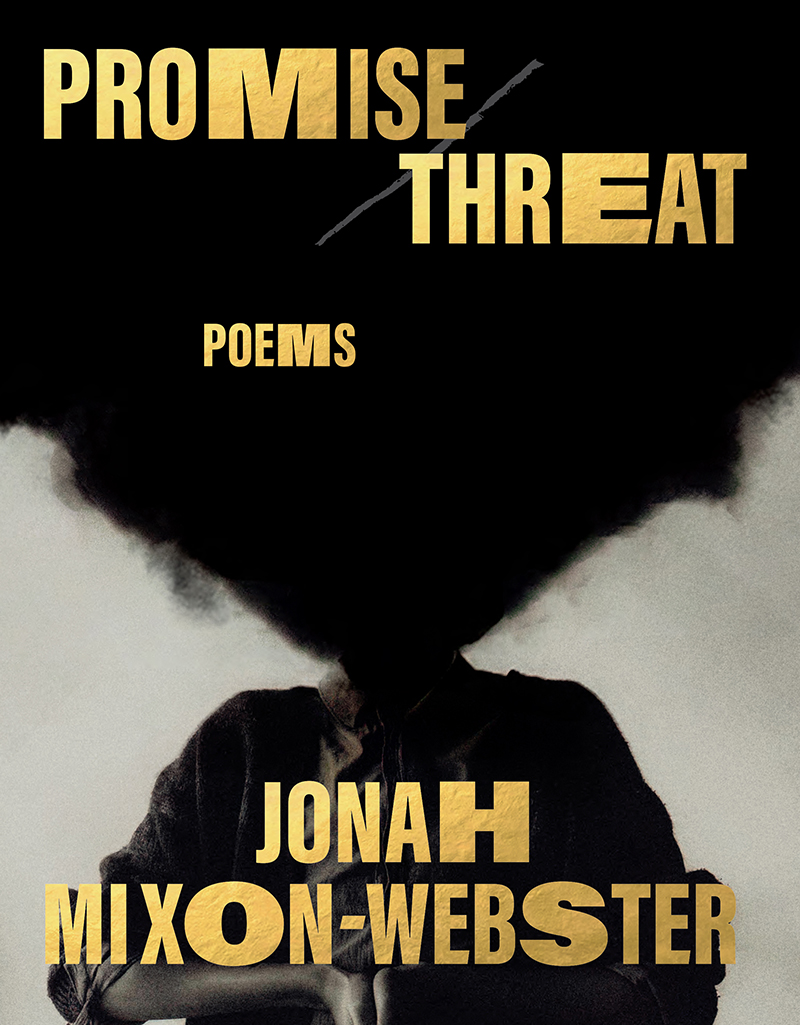
My dreams are so intense that I dread going to sleep sometimes — I’m terrified of what I might dream,” says Jonah Mixon-Webster, an award-winning, Flint-based poet whose second book was published on March 10.
Mixon-Webster has been working on Promise/Threat since around 2016, well before his critically acclaimed first book, Stereo(TYPE), was published. Stereo(TYPE) went on to win both the PEN/Joyce Osterweil Award for Poetry and the Sawtooth Poetry Prize, and it was a finalist for the Lambda Literary Award for Gay Poetry.
Both books explore dualities, Mixon-Webster says — more specifically, “How do you hold two things that seem to be opposite together at the same time? How do you literally take the good with the bad?”
Other dualities come into play in Promise/Threat (not least the book’s title): reality and make-believe, memories and lived experience, dreaming and waking.
Mixon-Webster describes having “very, very vivid” dreams that deeply affect him, even in his waking life. As he writes in the new book’s title poem, “the mind returns to the image in the dream.”
He isn’t always sure where a dream ends and waking life begins — especially since he sometimes dreams that he’s waking up. “That whole line between reality and dreaming just gets so blurred,” says Mixon-Webster, who has sleep apnea.
He’s also had lucid dreams, where he knows he’s dreaming and deliberately does certain things he’d be unable to do if he were awake — like fly, which he says “felt like freedom. It felt so free.”
The dualities in Promise/Threat extend to language itself. In the poem “Dollar Straight/Dollar Box,” Mixon-Webster plays with typography and font, arranging numerals sideways and upside-down across the page. The appearance of words, the visual medium of the page itself, “carries a meaning that also is a part of language,” he says. “Historically, the shapes of letters and the way they’re stylized dictate authority.”
Mixon-Webster’s work explores questions like “How can I think about what is being signified, or what messages or meanings are being made, by the way words are styled?” Put more simply, “What else can language do?” he asks.
The depth of Mixon-Webster’s questions, combined with the raw immediacy of his writing, has helped jump-start his writing career — in spite of an odd confluence of bad and good luck.
Just a year after his first book was originally published in 2018, Mixon-Webster’s then-publisher went out of business. Normally, that kind of timing could mean death for an up-and-coming writer’s career, especially a poet’s. But Mixon-Webster was soon approached by an agent with contacts at Knopf, one of the country’s biggest publishing houses.
“Let’s republish this thing,” the agent told him.
Mixon-Webster did a bit of reworking, added some material, and republished Stereo(TYPE) in 2021.
He describes Promise/Threat as Stereo(TYPE)’s “sibling.” Its poems ask, “What’s elation in love?” Mixon-Webster says. “What’s reverence for the beauty of nature? What does it mean to process grief for a loved one and still remain upbeat?”
Meanwhile, he wants readers to hear the following message: “Love is real. Love is possible. … You’re not crazy. If you need help, ask for it — and everything is going to be okay. We’re going to make it through this.”
This story originally appeared in the June 2026 issue of Hour Detroit magazine. To read more, pick up a copy of Hour Detroit at a local retail outlet. Click here to get our digital edition
|
|
|
|
|
|