What does it mean to be human?
A simple question to answer in just under two hours, no?
Maybe Happy Ending, the tender robot love story that earned six Tony Awards last year, takes over the Fisher Theatre through Nov. 1. And while its accessible story, charming cast, and spectacular set make for easy viewing, the musical asks the audience to think.
While many musicals open with a bang, this one begins with a soft crescendo. The experience starts before viewers sit down. As the audience trickles to their seats, a man reads in an armchair onstage while jazz swirls around the Fisher. As the lights dim, he drops the needle on a record player, and the tone shifts. The stage brightens to reveal a bedroom in futuristic South Korea. Enter male lead Oliver, who stretches his arms wide, transmits music from his barely moving mouth, and brushes his teeth — then his eyes.
Oliver is a Helperbot, a household assistant whose owner has “retired” him — though he refuses to admit it. At first, he appears content to spend his days reading Jazz Monthly, talking to his plant, and watching the world from his tiny apartment. He’s settled into a quiet existence in the Helperbot Yards, a building full of retired bots, as he awaits his owner’s return.
Twelve years pass before Claire, the Helperbot across the hall, knocks on his door in search of a charger — replacement parts for both of their models have been discontinued. Equal parts naïve and uppity, organized Oliver clashes with spontaneous, playful Claire, but what begins as a reluctant connection born out of necessity gradually gives way to something deeper. As two beings left to find a new purpose, they discover companionship — and the vulnerability that comes with it.
On its surface, Maybe Happy Ending has all the ingredients of a sci-fi Romeo and Juliet: star-crossed lovers destined to meet, seemingly irreconcilable differences (he’s a more durable Model 3, while she’s a more advanced Model 5), a love rendered forbidden by a looming expiration date, and an ending that ranges in tragedy depending on the viewer’s perspective. (This author personally left the theater in introspective silence, choked up for the full walk down the Fisher’s marble hallways.)
A Cleverly Crafted Original
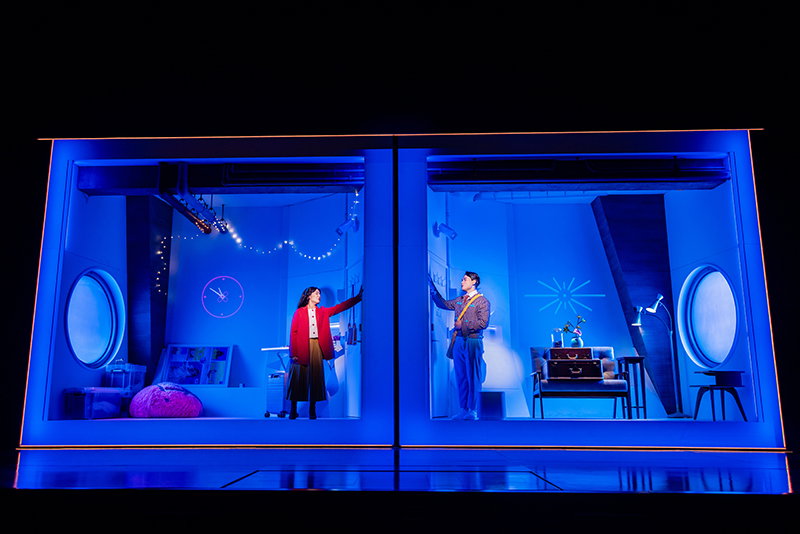
The production itself is precise and seamless. Sets glide across the floor, fitting together like puzzle pieces. Whether by the walls of the two bots’ rooms or a frame of neon light, many scenes appear enclosed, like comic panels brought to life. Names and timestamps project above the set, a cinematic way of grounding the audience. The lighting practically functions as its own character, brightening, warming, or changing color to reflect the passage of time and match the emotions of each scene. The setting perfectly captures the clean, crisp look of a future that, with AI ever evolving, doesn’t seem so distant.
Only four actors physically appear onstage — unless you count Oliver’s plant, HwaBoon, who gets his own playful biography in the Playbill.
Yet the production never feels small. Instead, the intimacy draws the audience closer to Oliver and Claire. And since the 100-minute show runs with no intermission, that connection is never interrupted.
Steven Huynh plays an endearing Oliver, complete with robotic mannerisms and a tone full of childlike optimism, capturing the warm lilt of a bot made to comfort humans. Claire Kwon (Claire) brings a voice as lovely as a songbird’s and comedic timing that lands authentic laughs — the writing is genuinely funny without trying too hard.
The show is clever in conveying the robots’ technical abilities. They open their mouths and emit the trill of a ringing telephone or a line of tinny, recorded dialogue in another character’s voice. They place two fingers to their temples, and a high-tech projection envelops the stage, fully immersing the audience as the robots search the web or filter through their memories.
The music is equally charming. The robots’ narrative songs feature soft, tinkling melodies — the kind that might play in a café: soothing and polished. Interspersed are jazz numbers reminiscent of the swing era. Though the show references real jazz artists like Nat King Cole and Duke Ellington, it also invents fictional artist Gil Brentley, who periodically swings onstage in a suit with all the swagger of Sinatra. The songs are original, but it’s easy to picture them crackling over a 1930s radio.
For a theater landscape crowded with adaptations of familiar stories, a wholly original production feels refreshing. You’ve never met these characters. You’ve never heard this story. But you certainly won’t forget it.
Michigan Connections Behind the Curtain
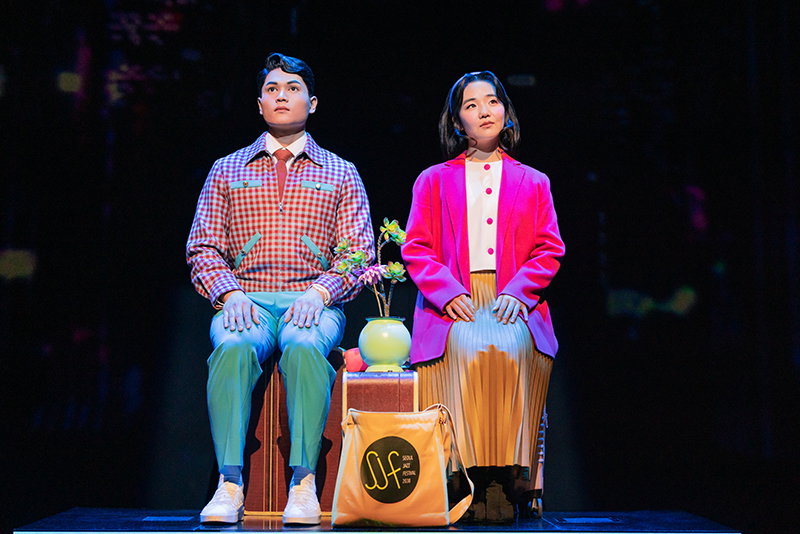
Though Maybe Happy Ending takes place outside Seoul, its creative team has strong Michigan roots.
The musical won six of its 10 Tony Award nominations in 2025, including best musical, best book, and best score.
Director Michael Arden and scenic designer Dane Laffrey took home best direction and best scenic design, respectively. The pair, who have collaborated on several projects and co-run the theater company At Rise Creative, met at Interlochen Arts Academy in Grand Traverse County. Arden has also won Tonys for directing the 2023 revival of Parade and for lighting design on The Lost Boys this year. Laffrey, born in Albion, won best scenic design this year for The Lost Boys, a rock musical based on the 1987 film.
Michigan touched the music as well. Both music director Josh Tatsuo Cullen and music supervisor Deborah Abramson were raised outside Detroit, and Cullen also attended the University of Michigan.
Darren Criss and Helen Shen, who originated the roles of Oliver and Claire in the musical’s first Broadway run, both graduated from U-M as well.
Criss had already garnered national attention, best known for portraying Blaine Anderson on Glee, founding the theater company StarKid Productions, and heading several Broadway shows. (Coincidentally, after the former Wolverine gained internet fame for playing Harry Potter in a musical parody, his first Broadway appearance saw him briefly take over for Daniel Radcliffe in How to Succeed in Business Without Really Trying.) Last year, he won the Tony for best actor in a leading role for his performance as Oliver. Now, he’s listed as a producer of the show.
The Human Touch
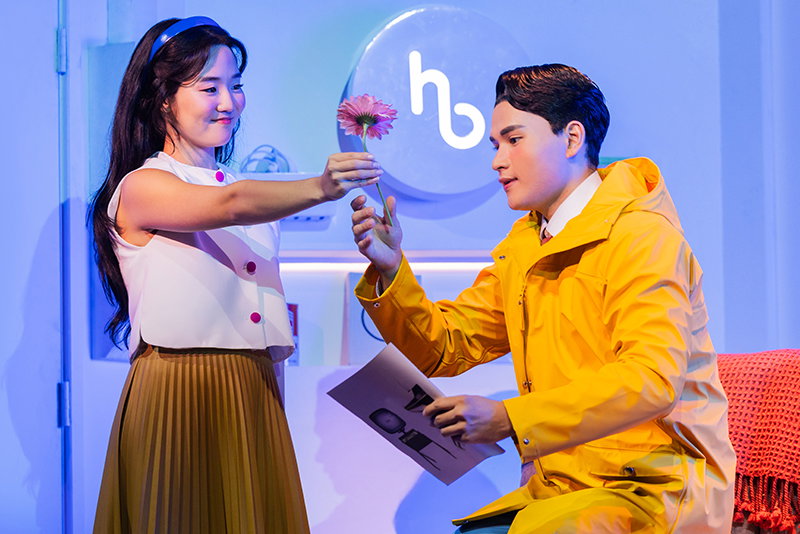
For all its futuristic flourishes, Maybe Happy Ending is concerned with questions that have plagued humanity for all of time.
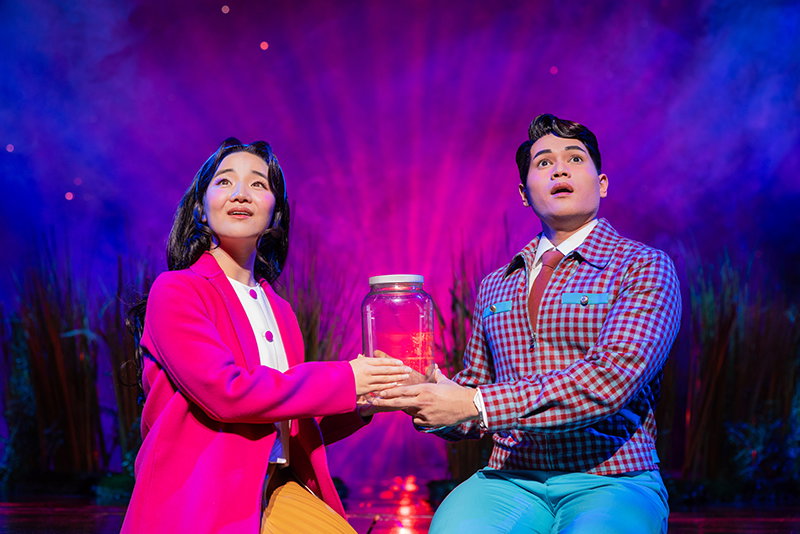
In one scene, Claire describes fireflies to an awestruck Oliver, fascinated by their ability to glow without charging any batteries. But she also notes their short lifespans: “They only live for two months, but what a beautiful two months.”
Therein lies the heart of the musical: When the ending is inevitable, is beginning worth the risk?
After all, the audience knows from the outset that with Oliver and Claire’s models considered obsolete, they will both power down in time. In moments both tender and contemplative, the musical probes the concepts of memory, impermanence, and the full spectrum of human emotions.
They discover that love risks heartbreak. Connection risks loss. And protecting oneself from pain can mean missing out on the very things that make life meaningful.
The best art lingers in the mind, inviting the audience to look beyond the surface, to seek themselves within it and unravel the meaning accordingly. Maybe Happy Ending will leave you thinking long after the curtain falls — and maybe humming a gentle melody on the drive home.
So, do Oliver and Claire get their happy ending? Maybe. Grab tickets for a show at the Fisher and see for yourself.
|
|
|
|
|
|