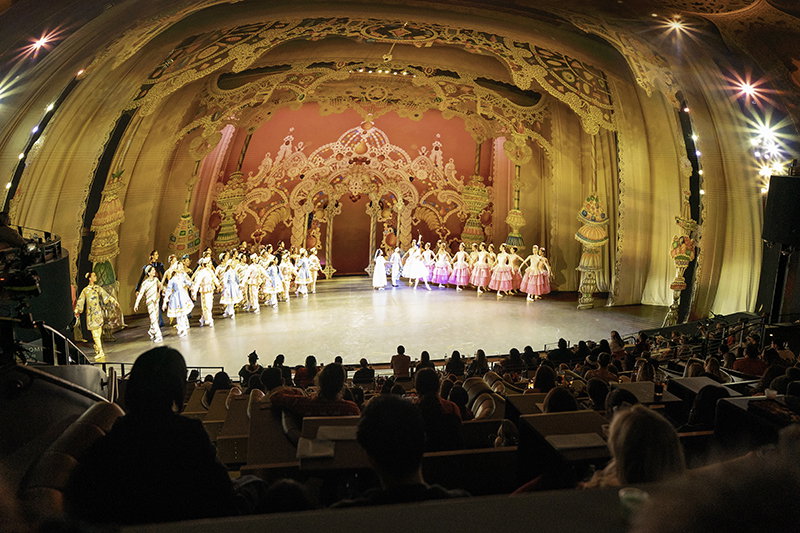
Cosm President Jeb Terry introduced George Balanchine’s The Nutcracker in Shared Reality at its world premiere in Detroit by sharing Cosm’s mission to transport viewers to somewhere they’ve never been before. The ensuing show lived up to every part of that mission.
I’ve watched hundreds of dance performances over the past two decades in every format imaginable: live and in person from the front row and from the highest balcony, in theaters that seat 200 people and those that seat 2,000, at the movie theater, on a TV at home, on a phone screen.
I’ve never seen dance quite like this.
As part of a partnership with New York City Ballet, Cosm took a production team to Lincoln Center for the Performing Arts in New York City to film the world-famous ballet company in its nearly 75-year-old production of The Nutcracker, choreographed by George Balanchine, an American ballet icon. Over a week of filming, the team captured the dancers — including dozens of students from the School of American Ballet — on more than 10 cameras exclusively for Cosm Detroit’s 87-foot domed LED screen.
The result was a wholly unique experience that brings a new sparkle to the classic ballet.
Up Close and Personal
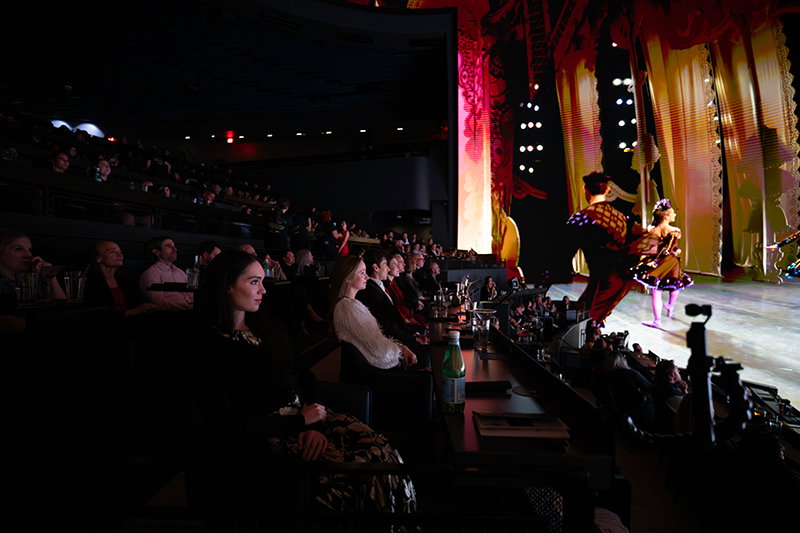
The enormous dome immerses viewers in the performance just by nature of its size, but the choices of camera angles give the audience almost a behind-the-scenes look at the ballet. Even when the camera frames the dancers head-on, it’s so close that you feel as if you’re sharing the stage with them — but the camera also dances all around the performers.
When the corps de ballet (the equivalent of the ensemble) twirls in intricate patterns, we watch them from above for a bird’s-eye view of the formations. As principal dancers Tiler Peck and Roman Mejia, dancing the lead roles of the Sugar Plum Fairy and her Cavalier, end their pas de deux (duet) with a dramatic backbend, we jump to the corner of the stage, seemingly inches from the ballerina’s fingers. When the mice of the first-act battle swarm onto the scene, we look on from backstage. At times, we’re even positioned at the back of the stage, looking out at the darkened theater, as if we’re part of the cast.
The abrupt and continual switching of angles could be jarring, but my viewing companion, who often finds similar editing disorienting, raved about the sense of closeness (neither of us have ever seen dancers’ faces so clearly in any performance) and how the position of the camera enhanced the effect of the dancing. Philippe Safir, who adapted and directed this performance for the screen, undoubtedly understands how best to capture the movement of dance.
Before the performance started, I was concerned that the curved screen would cause distortion of the dancers’ limbs, which would ruin the line and precision of the steps. That concern turned out to be unfounded. While some mild distortion occurred in the scenery — most noticeably in the Christmas tree as it grew — the dancers themselves appeared in perfect proportions.
Full Immersion
The intimacy and immersion the perspective offers was a key takeaway for Peck, who saw the finished product for the first time at the Nov. 4 premiere.
“You get so much more access than you ever would in a normal theater — I really felt like you were immersed,” says Peck, who has been a principal dancer with New York City Ballet for over 15 years. “I’ve always thought when you watch any sort of performance on video, the energy gets lost a little bit — it falls a little flat. With this format, you still get that [live-performance] energy because of the ability of the camera to move in a way and be in it.”
As the one drawback, the close angles, which limited the viewing frame to the stage rather than including some of the theater, reduced the sense of scale and grandeur that audience members get in person, or even from a traditional recording. My suggested remedy is simply to attend live performances as well. Each type of experience offers its own advantages that can’t be replaced.
The music also bears mentioning. The New York City Ballet Orchestra created a new recording of the Tchaikovsky score specifically for this project, and the production team added in sound effects where appropriate throughout. In particular, the battle scene, which I often find breaks my suspension of disbelief, became more dramatic and effective due to the sounds of clashing swords and a booming cannon.
Near the beginning of the second act, the sound cut out momentarily, and when it resumed, it was slightly out of sync with the video. The integration of music with movement makes dance what it is, so any desynchronization — no matter how slight — detracts from the performance. However, I’ll chalk the glitch up to opening night jitters.
Inspiring the Future
As a whole, the experience draws the audience in close almost as participants, not just spectators. I can clearly picture a child watching The Nutcracker at Cosm Detroit and imagining themselves there — onstage, backstage, part of the action. For many children in metro Detroit, it may be their first opportunity to see any production of The Nutcracker, much less a world-class production featuring the best New York City Ballet has to offer.
In partnering with Cosm, the ballet company kept that front of mind, aiming to expand its reach outside of New York City.
“Not everybody has the access and availability to come see something like George Balanchine’s The Nutcracker [in New York],” Peck says. “But to have the ability to watch a production like this in a city that you’re from or can maybe easily travel to and get to feel like you’re actually in New York City Ballet’s theater, I think that’s really important to hopefully inspire people who maybe didn’t even know they loved ballet.”
The Nutcracker — in any format — is often the catalyst that sparks young people’s love of the art form.
“There’s nothing like it,” Peck says. “It was the thing that made me want to be a ballerina. When I saw it, I thought, ‘Oh my gosh, Daddy, I want to dance on that stage someday.’ … It just feels magical to me every year I do it. It never gets old.”
The Nutcracker at Cosm is a prime opportunity for Detroiters to experience the magical ballet as never before.
George Balanchine’s The Nutcracker in Shared Reality is showing now through Dec. 31 at Cosm Detroit in Cadillac Square. Find showtimes and tickets at cosm.com/detroit.
|
|
|
|
|
|