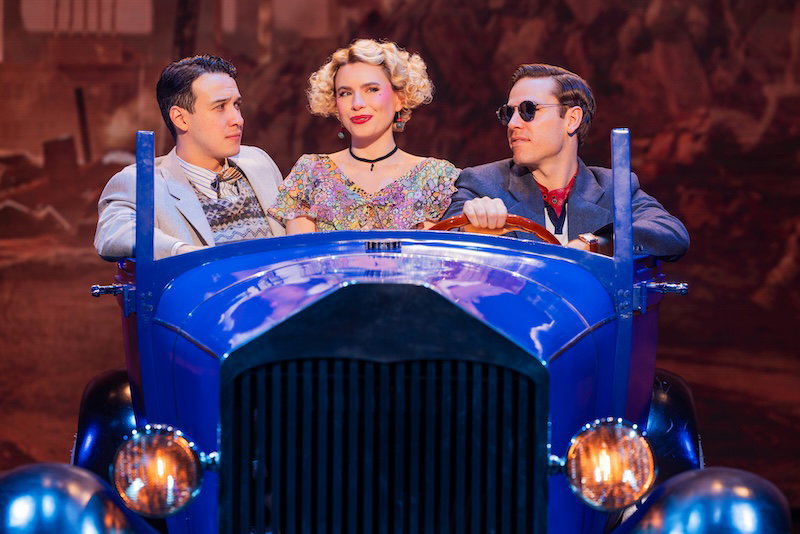
Before Will Branner set his sights on Broadway, he had his eye on a different type of role. In third grade, he told his mom that he wanted to be in a commercial.
“Not ‘I want to be an action star,’” he says. “But ‘I want to hold toilet paper or something in a commercial.’”
His mother took him to Matthews Playhouse in a suburb of his hometown of Charlotte, North Carolina. That’s where he landed his first onstage role as an Oompa Loompa in Charlie and the Chocolate Factory.
From third grade on, Branner’s extracurriculars came in threes: He performed in about three musicals a year while being a three-sport athlete — “a full Troy Bolton, High School Musical moment,” as he puts it.
Still, Branner hadn’t quite considered theater as a full-time career. He planned to attend Florida State University for marine biology. That is, until a friend mentioned musical theater as a possible major. “They were like, ‘You never have to take a math class again,’” he says, “and I was like, ‘Great.’”
And so Branner applied to a slew of “big football schools that had musical theater programs” and found himself at the University of Michigan. “Somehow,” he says. “It still feels like an absolute miracle to this day. … It really was the quintessential college experience.”
A Wolverine in the Wings
Between classes and extracurriculars, Branner describes U-M’s theater program as “the best training in the country.” He learned from faculty with firsthand Broadway experience: he credits Cynthia Westfall, an original conductor for The Lion King, for fundamentally changing how he views music.
The university allowed him to explore a variety of disciplines. Alongside vocal and acting training, Branner experimented with directing, filmmaking, and production. He even worked directly with the Eagles and Air Supply to develop their respective musical projects.
“It truly changed me fundamentally as to how I approached the industry, and I feel indestructible from that training,” he says. “It gave me the slightest bit of confidence to go out into the real world and feel like I could be one of the leaders and best in any of the fields hovering around musical theater.”
Since graduating, he’s put his multidisciplinary education to work, starting off in Bat Out of Hell: The Musical in 2018 and directing several short films, which premiered to acclaim at film festivals across the country.
In 2023, Branner made his Broadway debut in Back to the Future, understudying both the notorious bully Biff Tannen and loveable nerd George McFly. “I rarely get to be the hero,” he says. “And it’s nice to be a nerd because I am a nerd. I love cultivating that part of myself.”
After a stint in London for punk-rock musical American Idiot, he returned to the Winter Garden Theatre for a brief run as Biff in 2024. He calls the production “a dream come true” — and not just because Steven Spielberg attended the premiere. It was the cast, he says, that made his first Broadway experience so memorable.
Also in 2023, Branner joined a cast packed with former Wolverines in Nerdy Prudes Must Die. The comedic musical comes from StarKid Productions, a theater group founded by U-M acting students (including Tony Award-winning actor Darren Criss) in 2009.
Even as a U-M student, he’d never heard of the company. But once he joined the production and began exploring StarKid’s catalog (more than 30 shows are available for free on YouTube), he was smitten. “I was like, these are my people,” he says. “I feel stupid. I feel late. My ego dissolved in a minute.”
In early 2027, Branner and the rest of the original cast will take Nerdy Prudes Must Die to London’s West End for a limited engagement. (Writers Nick and Matt Lang and director Lauren Lopez are also U-M alumni.)
Now, Branner is taking a page from StarKid’s playbill, working to make musical theater as accessible as possible. On his YouTube channel, LordBranner — which he launched while touring with The Great Gatsby — he sits down with fellow Broadway cast members to analyze pro-shot productions, revealing behind-the-scenes details and digging into the craft. The channel has already garnered more than 25,000 subscribers, inspiring theater fans across the globe.
“What started as a silly goose YouTube project is turning into something that’s cultivating my artistry in such an amazing way,” he says. “And it’s something that’s going to blossom and expand with every cast I’m in.”
The cherry on top, of course, is Branner’s latest role: Tom Buchanan, the central antagonist of The Great Gatsby, playing at the Fisher Theatre now through Nov. 29.
View this post on Instagram
Love to Hate Him
With his sunny, enthusiastic demeanor, Branner doesn’t exactly scream “villain.” Gleeful, giddy passion bubbles from his voice as he speaks. Yet onstage, he transforms into a grisly, loathsome Tom Buchanan. He maintains a steely glare, his voice takes on a menacing tone, and his lines spew venom. He comes off as every bit the slimy “brute” the other characters claim him to be.
This is hardly Branner’s first turn as a bad guy. There’s Orin in Little Shop of Horrors, Biff in Back to the Future, Max Jägerman in Nerdy Prudes Must Die. The pattern is clear: Branner likes to be the character you hate.
“The ideas just start to flow in when I read the villain characters,” he says. “The villains are fun. They carry the lesson, and they’re one of the most iconic parts of the show. One day I’ll play Regina George in some cabaret.”
Unlike his previous villains, however, Tom’s comedic moments are few and far between. His character is surrounded by darker themes — abuse, infidelity, the corruption of wealth — leaving Branner little room to “hide behind humor.” He notes it was an extra challenge to be “genuine and awful.”
How does he find it within himself to play the brute? He lets the character take a step toward the light. “You flash the audience brief moments of hope for Tom and hope for a redemption arc, and then you rip it away,” he says. “I’ve developed moments where the good choice is in front of him, and he actively chooses not to do it. I think we see a lot of that in our world currently, where people in positions of power or who have lots of wealth and resources are continually making the clearly self-serving decision.”
The Text of Time
More than a century after The Great Gatsby’s Jazz Age setting, the question lingers: Can we repeat the past?
Well, old sport, apparently we can.
When F. Scott Fitzgerald published the novel in 1925, few could have predicted its eventual place in America’s literary canon — including its publishers. Even Fitzgerald himself considered the slender book an abject failure: It sold fewer than 25,000 copies before his death in 1940.
Now, what many consider the Great American Novel sells more than 500,000 copies annually — with more than 30 million copies sold worldwide over the past century.
Clearly, Fitzgerald struck a nerve in the American psyche — whether through Jay Gatsby’s blinding hope, Daisy Buchanan’s pursuit of security, Jordan Baker’s independence, or Nick Carraway’s distant observance of it all.
It’s little wonder The Great Gatsby makes for compelling musical theater. It marries the glamour of the Roaring ’20s with the haunting pursuit of a dream that remains perpetually out of reach, slipping through our fingers as soon we grasp it. Gatsby’s lavish parties are the ultimate distraction from the distress of the age. Some characters surrender to the spectacle; others, like Tom, dismiss it as “the fall of civilization.”
Branner sees Gatsby as more relevant than ever. “The book is dealing with rapid advances in technology, people in different fields of business getting rich very quickly, how society reacts to that … the pitfalls and power structures that it changes, and who’s trying to keep the old ways in place,” he says. “Those [ideas] alone are very generic, but already you’re conjuring up 2026 imagery.”
He points to the AI boom — and its potential impending bust — as a contemporary parallel: a new frontier of American business that could collapse as quickly as it rose. “We’re having our own little Roaring ’20s right now, and it’s roaring in a scary, uncharted way,” he says. “And they were going through the same thing [in the 1920s]. They had no idea what the world was going to look like, but everyone was pretending they did.”
View this post on Instagram
Coming Home
Gatsby isn’t entirely doom and gloom. It’s also largely responsible for the gleaming allure associated with New York. Like many, Branner read the novel in school. He admits that it may offer a slightly more accurate depiction of the state’s “grandeur and chaos” than his other favorite New York art piece — Home Alone 2.
Though he’s called the Empire State home for nearly 11 years, Branner is embracing the opportunity to reconnect with his past on Gatsby’s national tour.
The show recently stopped in Charlotte, where Branner’s former English teachers saw him perform the story they’d once discussed in class. Now, as the musical makes its way to Detroit, he returns to the city where he once watched U-M alumni onstage, envisioning being in their shoes.
“I can see a little version of myself out in the audience,” he says. He pictures himself, college-aged, sneaking away from Ann Arbor, scanning playbills for U-M graduates who had joined national companies almost immediately after graduation, “dreaming and scheming” to follow in their footsteps. “I performed for Will the young Charlottean who had a dream of being on Broadway, and now I get to step onstage and be the guy I used to watch in Detroit and study and observe and dream about.”
What to Expect from Gatsby
The stage is only so big, but The Great Gatsby conjures up a pageant that feels larger than life.
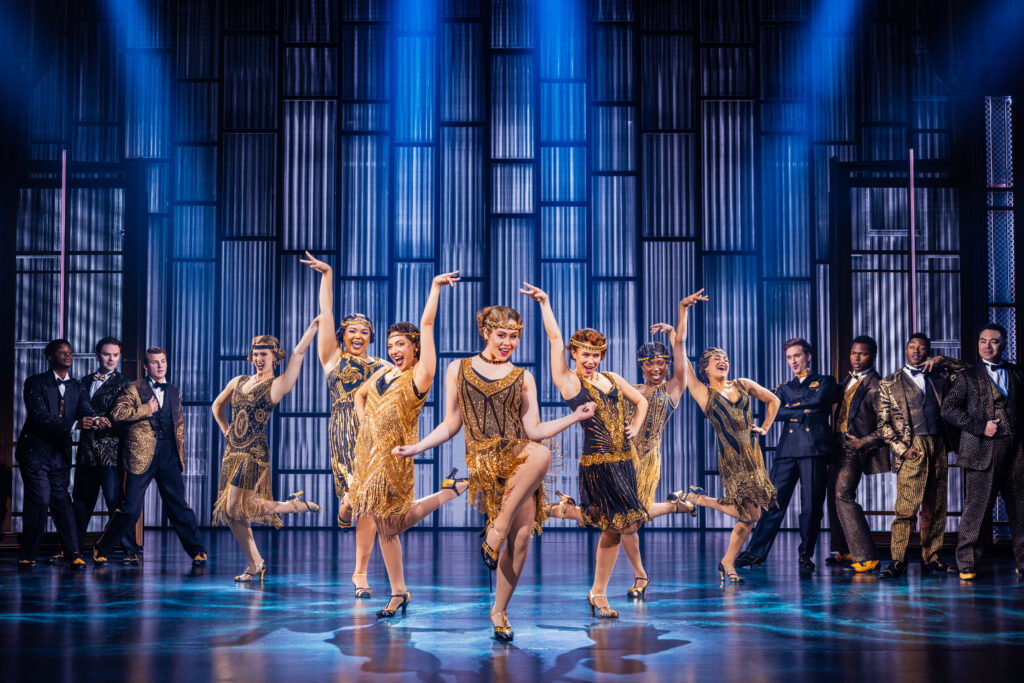
The Art Deco set pieces loom like Manhattan skyscrapers. The entire production drips with 1920s glitz and glam. Champagne practically courses through its veins.
From the flapper-inspired (Tony Award-winning) costumes to the Charleston-infused choreography, every detail sweeps the audience into the Jazz Age. The soaring musical numbers shift between humorous, flashy, and deeply emotional, but each song swells toward a satisfying belt. The production reflects why the decade remains so irresistible, even to those who know better.
Fitzgerald’s story needs little introduction. The musical is easy to follow even for those who have never read the book. While it retains the exploration of class struggle and the ever-elusive American dream, it adds a romantic thread and an unexpected redemption arc. It rearranges some of the novel’s most recognizable quotes — magnifies some, muffles others, completely omits still others. And surprisingly, for a play with a man’s name in the title, one might expect it to spend more time delving into, well, Gatsby. By-the-book purists may find the changes disconcerting, but that doesn’t negate the true green light of the show: the cast.
The stars shine as brightly as the glittery facade that surrounds them. Some have performed a version of Gatsby on Broadway, one actor through the American Repertory Theatre, even some in Seoul. “It’s like ‘Avengers assemble’ of Gatsby things,” Branner says. “Everyone has different expertise and exposure to the story.”
That range is evident in the performances. Austin Colby brings soulful tenderness to Jay Gatsby. Senzel Ahmady gives Daisy Buchanan a layer of melancholy that surfaces in her most vulnerable moments. And Leanne Robinson lends Jordan Baker sassy wit and a modern sense of autonomy.
Joshua Grosso — whom Branner calls “the greatest actor of our generation” — plays a standout Nick Carraway. Seeing his acting choices up close was a show in itself — every movement, every expression, the delivery of every line spoke of an artist deeply enveloped in his craft. No note felt forced. He rattles off lines with impeccable comedic timing, his powerful voice effortlessly takes over the room, and he delivers the full spectrum of the great narrator’s mystery.
Keep an eye out for D’Marreon Alexander in the ensemble. The Motor City native attended Detroit Edison Public School Academy’s Early College of Excellence and earned his bachelor’s in musical theater at Western Michigan University. He’s since set out on several national tours — and you may even catch him understudying as Nick or the seedy mobster Meyer Wolfsheim.
And, of course, don’t miss Branner as the boorish antagonist, who combines commanding vocals with dirty mannerisms that make Tom Buchanan feel perfectly slappable.
The Great Gatsby beats on at the Fisher Theatre now through Nov. 29. To support Branner’s mission of furthering access to musical theater education, search for LordBranner on YouTube and Patreon.
|
|
|
|
|
|