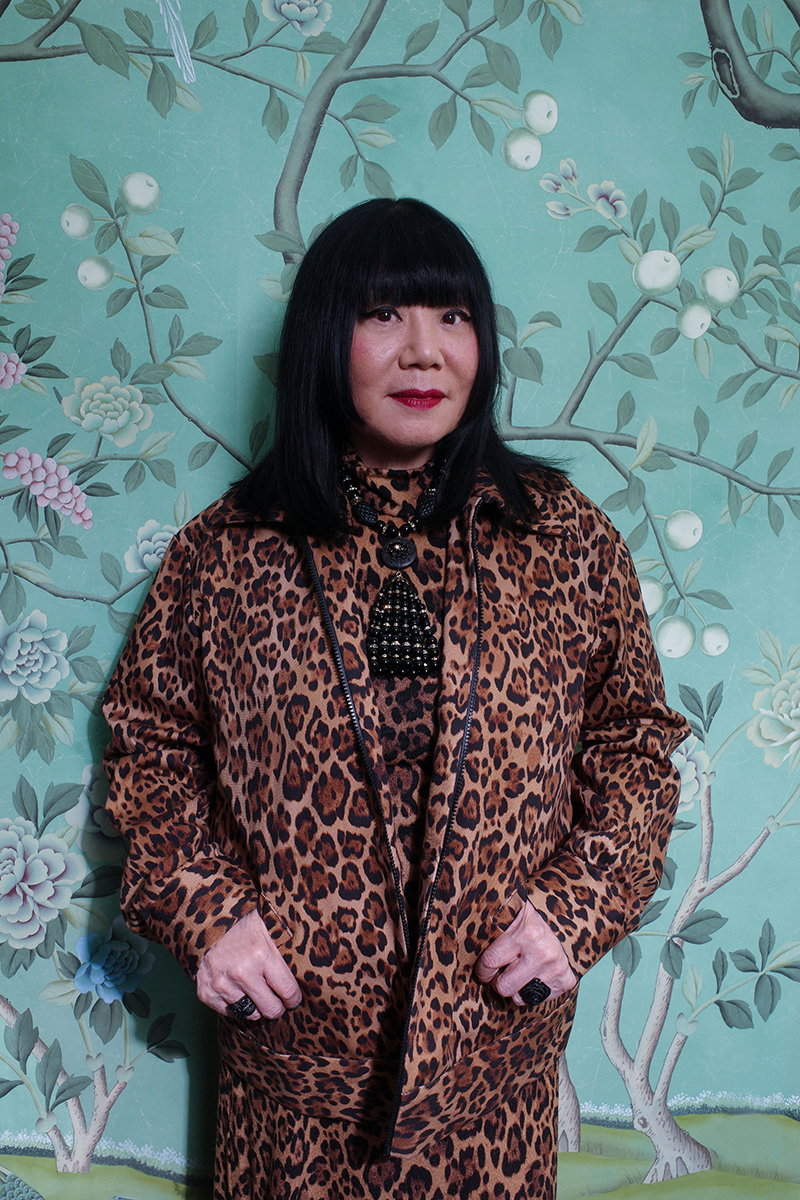
Anna Sui is a global fashion superstar, maximalist role model, and doting aunt. Now, as a major retrospective of her work and life lands in the Detroit suburbs, her world, it turns out, is not only about fashion and fame; it’s about family.
The halls of West Bloomfield High School served as Anna Sui’s first catwalk. Obsessed with popular culture, especially British rockers and models who “dressed like dandies and peacocks,” she clipped their pictures from magazines and stood in line to meet Jean Shrimpton, “the face of Yardley London,” at Hudson’s downtown department store. She went to concerts with her older brother, Bobby, because he had a driver’s license: Led Zeppelin at the Olympia, Iggy Pop and MC5 in Rouge Park. When she found out that the only store selling Jelly Babies, the Beatles’ favorite candy, was in Windsor, Ontario, she asked her parents to drive her across the border to buy some.
She especially adored the Mods, with their miniskirts and freewheeling spirit, and channeled that passion into her own designs. “Back then, fabric was so inexpensive, and there were great fabric stores,” recalls the best fashion designer to ever come out of metro Detroit — and one of the best American designers, period. “Even Kmart had a great fabric department. I used to go there on the weekend and make all these little miniskirts and then have all these new clothes for the week.” She never wore the same thing twice.
Of course, she won best dressed in mock elections. “That was fun,” she says, a touch of nostalgia in her warm, soft voice. Her senior year, she added a feather boa to her signature style.
Sui was, as they say, extremely goal-oriented. She decamped for a Manhattan art school at age 18, chasing the dream she’d had since she was 4 to live in New York and be a fashion designer. Little did she know that her dream would give rise to a global fashion and beauty empire.
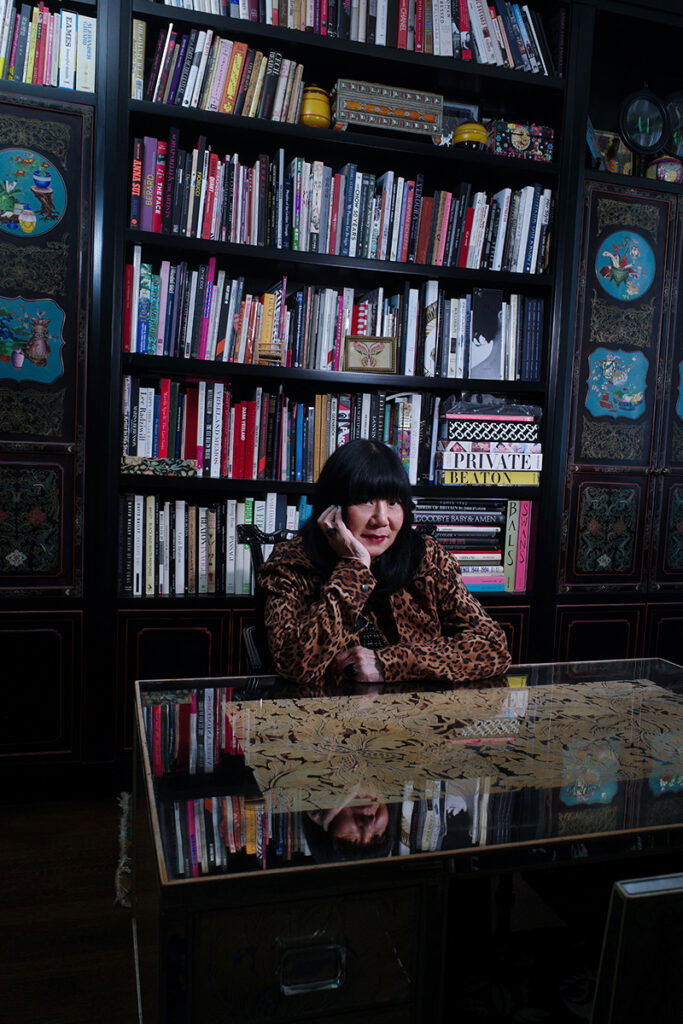
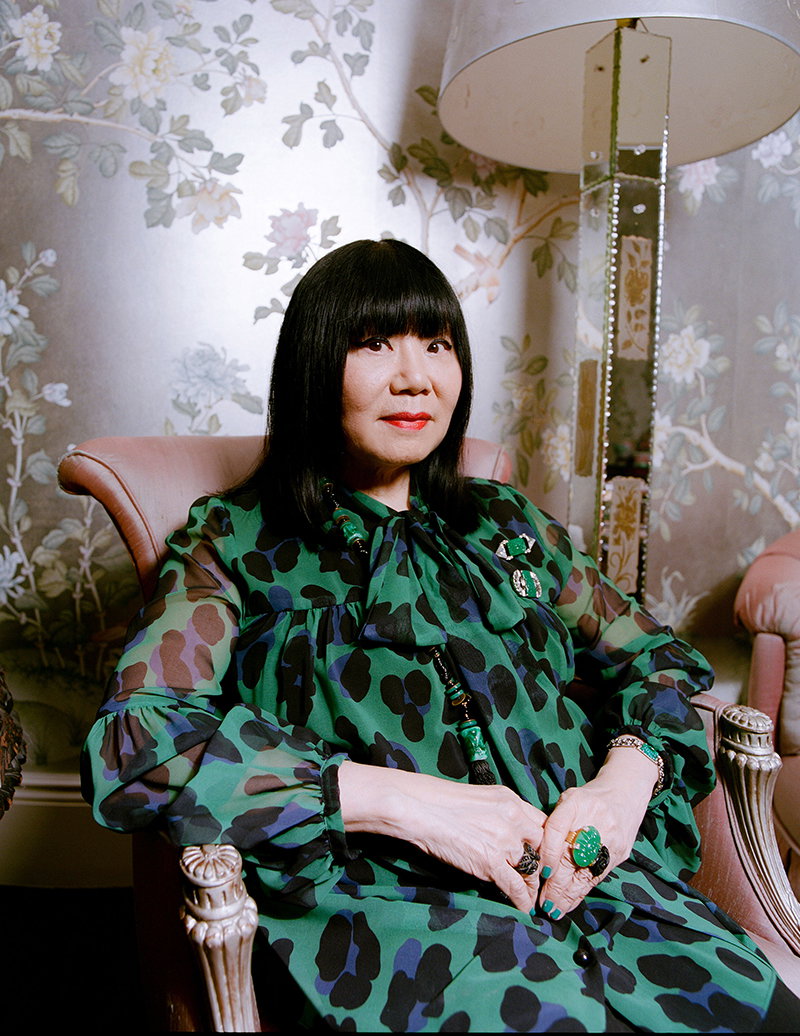
Meeting Sui feels familiar, for she has long been the legendary face of her eponymous brand. Her crimson lip, winged eyeliner, and signature jet-black, eye-skimming bangs have a timeless quality. She never moved back to Detroit, but she visits often. Her two brothers still live in the suburbs, and seven of her nieces and nephews attended Cranbrook schools.
She calls the shots from her headquarters on the 11th floor of a 1920s office building in the Garment District. In the 1990s, the canny businesswoman made lucrative licensing deals in Asia that let her remain independent.
“I didn’t have to get a business partner,” she says. “I didn’t have to get people to invest. I’ve always done what I love, and I don’t have a boss to answer to.”
That means having most of her clothes sewn in New York City, a rarity in these days of cheaper overseas labor. Her accountant may object, but Sui is determined to preserve the city’s once-bustling Garment District, the place that made her great. But it was the Detroit of the 1950s and ’60s — its concert arenas, its design legacy, its glamorous department stores and gritty thrift shops — that fed her innate artistic talent.
“I grew up in the golden era of Detroit,” she says. “It was very rich, very, very cultured, and had incredible stores. I saw all the fashion of the moment. Hudson’s carried all those things that were in Vogue or Mademoiselle or Glamour.” A tireless shopper, she can still reel off the stores: Jacobson’s on Michigan Avenue; J.L. Hudson’s on Woodward downtown, especially at Christmas; the Northland Center, where she got her first Betsey Johnson dress; Saks at the Somerset Mall, with its high-end designer fashions from France.
“I mean, everything passed through Detroit,” she says. “All the British bands passed through. It was a major city in the United States. The automobile business was so successful at that point, and there were a lot of very wealthy, sophisticated people. We had all those great designers coming out of Detroit, like Alexander Girard and the Eameses. They all worked for Knoll. The Saarinens influenced a whole generation of designers.”
That Sui springs from a design mecca comes as no surprise, but the hum of entrepreneurship and industry clearly left a mark. You do not start your own label out of your apartment in 1981 and go on to survive 50 years in the fickle fashion business — weathering economic collapses, national tragedies, and a pandemic — without the determination and resilience of the type that the Motor City exhibits.
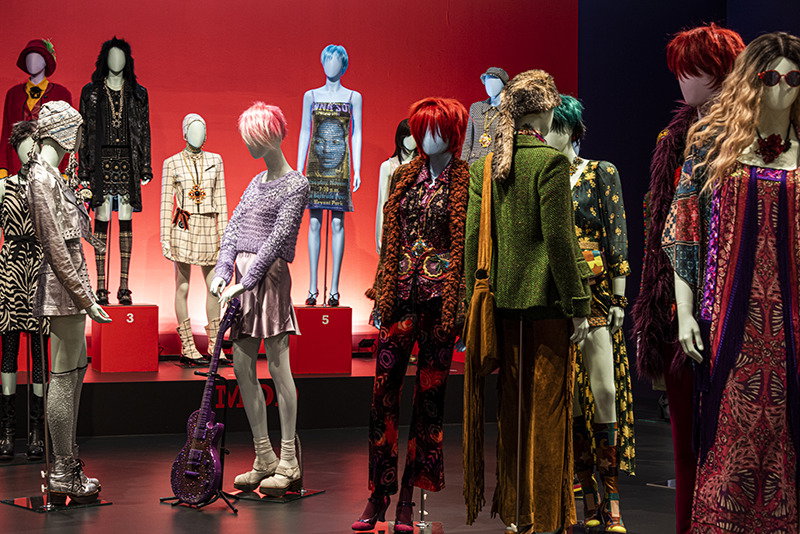
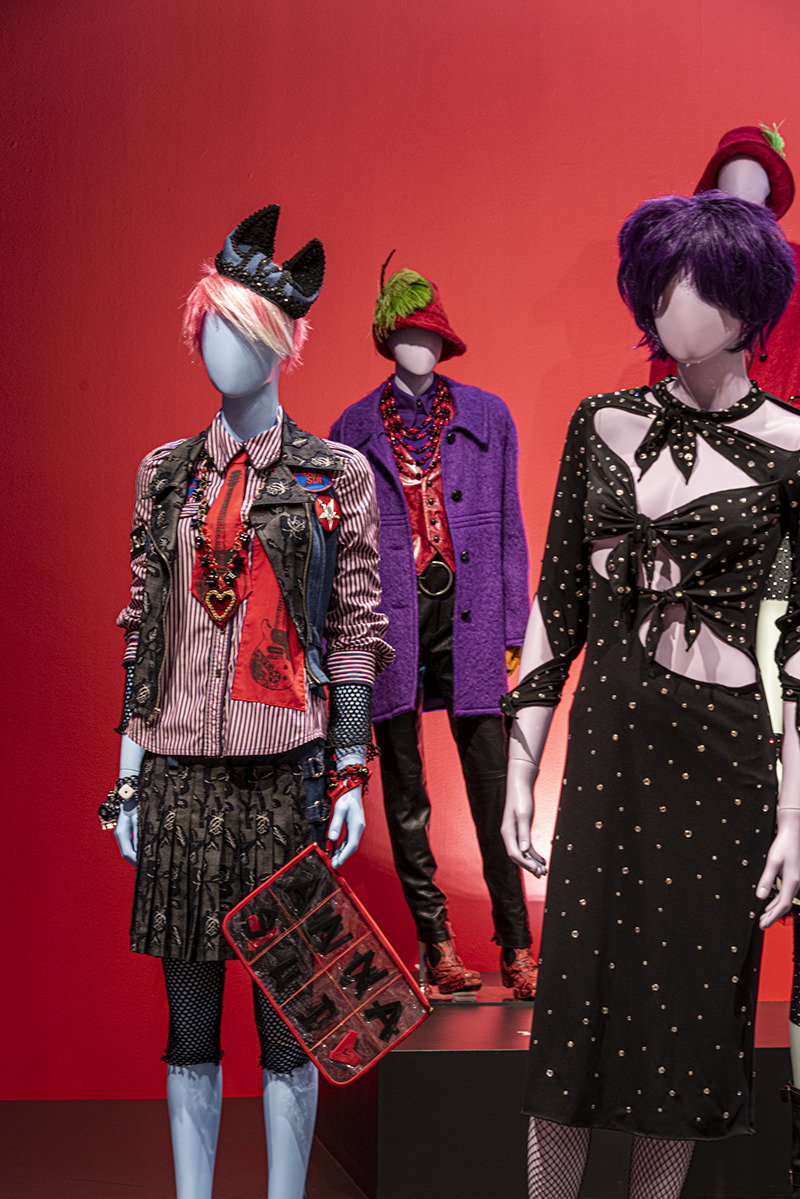
Thus, it makes all the sense in the world that The World of Anna Sui, a traveling exhibition showcasing the iconic designer’s astonishing clothes, influences, and creative process, opens in October, only a few miles from her high school hallway fashion shows.
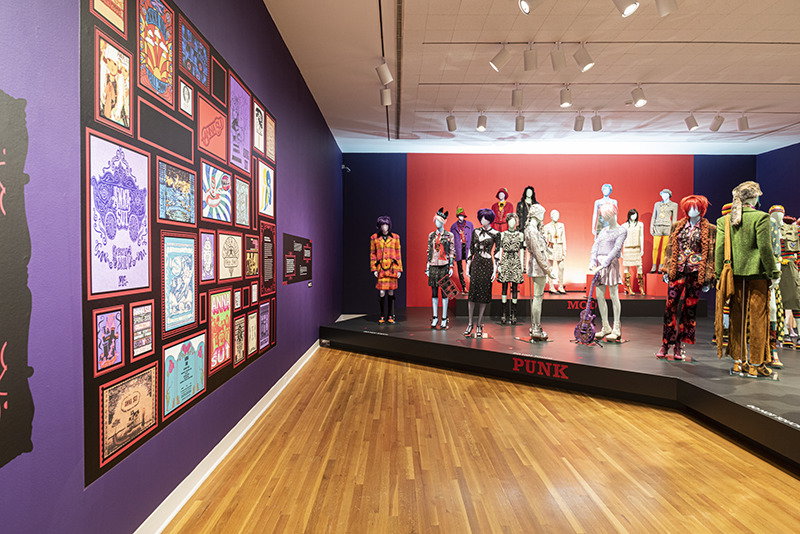
The exhibit originated in London in 2017, and after stops in eight cities, including New York, Fort Lauderdale, and Shanghai, it has landed in Bloomfield Hills at the Cranbrook Art Museum. The exhibit includes almost 100 garments, along with elements of her singular world, organized thematically and touching on her various design “alter egos”: pirate rock stars, surfer nomads, grunge girls, pre-Raphaelite maidens.
Like her clothes, Sui is intensely feminine. Today she wears the Cottage Rose Lace Top, a lacy confection from her spring/summer 2026 collection, and a gothic crow brooch from Hotcakes Design, a favored vintage jewelry designer. On her hand, one of her Rouge rings, a black Bakelite-style rose, opens to reveal lip gloss, an example of the brand’s whimsical and clever product design. It’s summer-in-the-city hot outside, but up here in Anna Land, it’s quite cool.
The showroom replicates the boho, rock ’n’ roll vibe of her fabled Soho boutique: scarlet floors, purple walls (her favorite color), Tiffany-style lighting, and psychedelic rock posters. There are assorted pieces of chunky Victorian furniture black-lacquered to a high gleam, another piece of her trademark aesthetic, along with Art Nouveau graphics. Three “dolly heads,” her iconic Styrofoam-and-paper-mache mannequin heads that resemble surreal 1920s flappers, stare down from a high shelf, while her Resort 2027 collection hangs on racks by the window, some of the garments so diaphanous and floaty that butterflies and hummingbirds may have had a hand (or a wing) in the stitching.
Holding up a faux-fur jacket in a rich, jewel-tone green, Sui explains that 1960s painter Pauline Boty inspired her color palette for the collection. “She was the only woman in the pop art movement in London,” she says. “This jade green color is one that she used a lot in her paintings. … It just so happened her colors were what I was thinking for the season. So my inspiration board is all her art on the wall.”
The reference may be obscure, but Sui is a pop-culture sponge. She absorbs music, movies, books, her extensive travels, other designers, other eras, and reinterprets them into deliriously inventive mash-ups of color, pattern, material, and texture, generously accessorized. Her supermodel friend Naomi Campbell calls her “Super Sui” for her encyclopedic knowledge of everything related to culture and style. When designing a collection, Sui notes, “there’s something that influences me — an event, a movie, a book, a personality … and that’s how it happens. I like understanding what the catalyst is.”
A famous story has it that when Sui was 4, she was the flower girl at a relative’s wedding in Manhattan. That was the catalytic event, the moment, she says, when her destiny became clear: “The tall buildings, all the traffic, and my aunts and uncles were all so glamorous. It was just so dazzling. I thought, ‘Oh, I want to live in New York, and I want to design clothes.’”
She imagined herself “draping beautiful fabrics on a mannequin and then going out to lunch with this big portfolio” like the fashion designers she saw on TV. “I spent my childhood figuring out how to get there,” she says.
Luckily, her parents understood. Chinese citizens Paul and Grace Sui studied in Paris after World War II: for him, bridge engineering at the prestigious Ecole Nationale des Pont et Chausses; for her, painting at the Sorbonne. They married and had a son, Bobby, but when the Communists came to power in China in 1949, “they didn’t have a country to go back to,” Sui says. The young family immigrated to Michigan, and Paul studied for his master’s in engineering at the University of Michigan. He settled into a long career as a structural engineer for Smith, Hinchman and Grylls (now SmithGroup), the largest and oldest architectural firm in Detroit. When asked what her favorite downtown skyscraper is, Sui replies, “The Penobscot” because that’s where her father’s office was.
Her mother held down the home front. “She loved crafts,” Sui says. “She crocheted; she knit. Back then, home sewing was really big, so she would make really cute dresses for me. We would go downtown to Hudson’s, and they had this incredible fabric department with all the pattern books. We would spend hours there. And I remember, not only did they have fabrics, but they also had a notions department with little silk flowers and buttons. And so we would just spend hours putting together outfits, and then she would make them for me.”
In her Barbie-themed bedroom, Sui cut the scraps into outfits for her dolls, practicing mixing and matching patterns, even on the shoes. “As soon as I was able, I took a home-ec class and learned how to sew.” (She now has a Barbie modeled after her.)
The Suis were the only Chinese family in Dearborn Heights, but they were American through and through. “We were a novelty, not a threat,” she tells writer Tim Blanks in the exhibit’s companion book, also called The World of Anna Sui. “If we went to a football game in another school district, we’d get teased. I’ve been wondering lately if making my own world was maybe my own subconscious way to underscore the alien, to define myself outside the culture.”
When Sui was in 10th grade, the family moved to West Bloomfield, and she began an obsessive love affair with vintage clothing and furniture that continues to this day. One of her early finds resulted in a key element of her world aesthetic.
“I found an old vanity at the Salvation Army downtown,” she recalls. “It looked like it had been in a fire, all smudged with smoke stains. When I brought it home, my mother was horrified. And she’s like, ‘What are you gonna do with that?’ And I said, ‘I’m gonna paint it black.’ And that’s what started me painting everything with black lacquer. I used that same concept to decorate my store [in 1992] because we didn’t really have money. So I just went to the flea market and bought all these kind of very rococo-looking pieces, and we painted them black lacquer.”
She still has the vanity but closed the boutique in 2020 after 28 years. (A second boutique in Los Angeles was short-lived.) Four Anna Sui boutiques still operate in Japan, but the SoHo store now exists as a fond memory for many people — including Laura Mott, chief curator of Cranbrook Art Museum. In 1997, she and some high school friends took a senior trip from Texas to New York City to hit all the cool boutiques, like X-girl and Anna Sui, in search of a prom dress: “It was our little dream trip as teenage girls to go shopping in these places.” Cranbrook doesn’t usually do fashion shows, Mott says, “but it’s exciting for us to bring someone who is such an amazing local talent. … She has such relevance now because so much of it is about ’90s nostalgia, if that makes sense. She’s very much of the moment, which is very exciting.”
Sui’s fashion-designer dream did not include the University of Michigan, her father and older brother’s alma mater. She discovered the Parsons School of Design in Manhattan through ads in the back of her babysitter’s Seventeen magazine. Later, she read an article in magazine about two young Parsons graduates who opened a boutique in Paris. She applied, got her grade point average up, took her first art classes, and assembled a portfolio consisting of a self-portrait and chalk pastel drawings of rock stars Eric Clapton, Janis Joplin, Yoko Ono, and George Harrison. The school accepted her right away.
Toward the end of her second year at Parsons, Sui overheard a conversation between two seniors about a job opening at Charlie’s Girls, a popular junior line in the 1970s. “And I thought, ‘That’s where I want to work,’” she says. “So I put together my portfolio from school, and I ran up there, and I got the job.” She has said that her thirst for knowledge may be compensation for her lack of a college diploma, but her kind of genius doesn’t need one. (Parsons gave her an honorary degree in 2017.)
Recently, she reconnected with the head designer of Charlie’s Girls, Erika Elias, who explained why she hired Sui. She said, “‘Because when you walked in, you were such a sight. You had the cutest pinafore on over flare pants and big platform shoes and all these colors on your face. And I just loved the way you looked, and I thought, ‘This is who I want to design for me.’”
Sui spent the next 10 years in the fashion trenches, designing for sportswear companies — Bobbie Brooks, College Town, Glenora — and sewing her own clothes on the side. She was too successful. When her designs showed up in a New York Times ad in the late 1970s, her jealous boss at Glenora fired her. She took the severance check and opened her own business out of her loft apartment in Chelsea. By 1986, Macy’s and Neiman Marcus carried her clothes, and she wrote a shopping column in a hip downtown magazine called Details.
She styled fashion shoots on the side to make extra money, all of which she spent on clothes, and dove into the downtown club scene. Crucially, she surrounded herself with talented and creative friends who pushed her to do more. At their urging, she conceived her first runway show in 1991. Steven Meisel, her best friend from Parsons who had become fashion’s hottest photographer, connected her with Naomi Campbell, Linda Evangelista, and Christy Turlington — aka “The Trinity,” considered the first supermodels — and movie stars, including Madonna. Another famous story from 1990 holds that the white-hot star surprised Sui by wearing one of her black baby-doll dresses to a Gaultier show at Paris Fashion Week, giving her a shot of confidence.
The Trinity walked in that first show, their star power bringing the heat to Sui’s eccentric rock-fantasy style, which The New York Times wrote “evokes an addled ingénue unafraid of a drink or of letting her knickers show.” Her thumping track lists provided background energy. Vogue took notice. “Doing the fashion shows really changed everything,” she says.
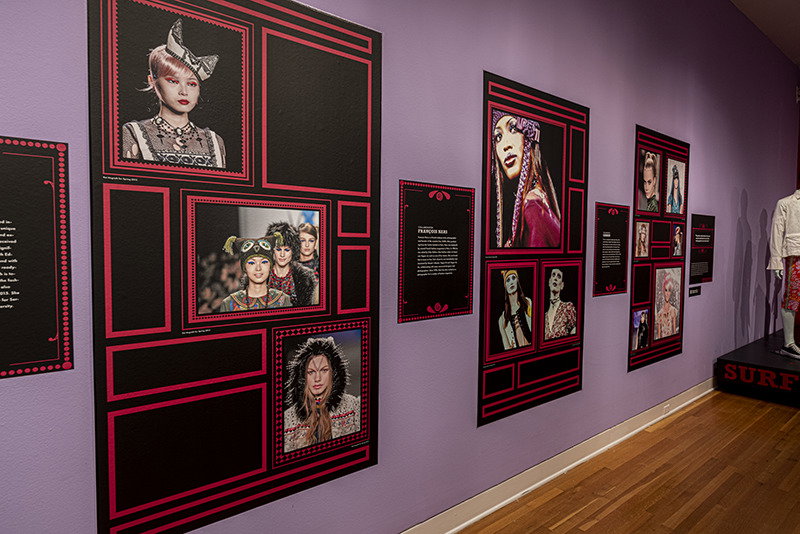
In 1993, after debuting her grunge collection to an edgy track list of Nirvana and Pearl Jam, Sui received the fashion industry’s version of an Oscar: the Perry Ellis Award for Best New Talent from the Council of Fashion Designers of America (CFDA).
She expressed her shock to the Detroit Free Press: “I always thought I’d been in the business too long to receive this award. But things happen for people in different ways. Fashion kind of changed into what I’d always believed in.” Next thing you know, she’s dressing Mick Jagger for an appearance on Saturday Night Live.
When Sui came back to Detroit, she found herself a celebrity. Suddenly, people were coming to see her at Marshall Field’s and Neiman’s and Bonwit Teller. “It changes when you walk into a place and you’re the one being stared at; you’re not the one doing the staring,” she told the Free Press.
She captures the heady early days in her book, The Nineties x Anna Sui, a collage of backstage photographs and interviews with her celebrity friends like Sofia Coppola.
Sui takes her friendships seriously and remains close to many of the old crowd. She recalls a recent book signing by her design contemporary and Parsons classmate Marc Jacobs, where she ran into the supermodel Helena Christensen.
“We were talking, and she’s like, ‘Didn’t we have so much fun in the ’90s?’” she says. “When you look at these pictures backstage, it was like we were all friends, and we all knew each other, and it was so much more intimate and quiet. And it wasn’t about business; it was about friendship. Because the internet changed everything.”
Sometimes, Sui’s Detroit past and New York present overlapped. In the mid ’90s, General Motors asked her and four other designers to create custom GMC Yukons to be auctioned off to benefit breast cancer research. (Sui adorned her metallic purple vehicle with black roses and leopard-print carpet.) When she and her parents attended a related event at the GM Technical Center in Warren, her father revealed that one of his first jobs was working with Eero Saarinen on the building in the early 1950s, before she was born.
Her parents, her biggest fans, attended every show. Paul and Grace were such fixtures that the fashion press sought them out for interviews. Her father, who had taken freelance jobs to support her efforts in New York, snapped photographs from the front row, rushing to have them developed the next morning. She always reserved a block of front-row seats for her friends and family, including her younger brother, Eddy.
“When we were young, she was always so creative,” recalls Eddy, who shares his sister’s passion for music and helps curate her runway-show track lists. “I remember her making dresses for her dolls and making the rooms of a house out of shoeboxes. It was pretty cool when later, I was in New York and walking down Fifth Avenue and seeing her clothes in the street windows of Saks or Macy’s — or both.”
Today, Eddy is the management director for wealth management in the U.S. at UBS Financial Services. He has offices in the Kresge Building across from the former J.L. Hudson’s site, where his sister fangirled over Jean Shrimpton and shopped for buttons and bows. Eddy admits that being related to one of the world’s top fashion designers has its benefits — hanging out with supermodels and rock stars, for example, whom he calls “normal people. They do fun things, but they happen to be super famous and many times incredibly beautiful or interesting.”
As always, the family was with Anna in 2009 when she accepted the CFDA Geoffrey Beene Lifetime Achievement Award, given to her at Lincoln Center by Jack White, another Detroit icon and longtime friend. (They met when he was married to model Karen Elson.) He wrote a forward for her first coffee-table book; she designed the salesgirls’ uniforms in bumblebee hues for Third Man Records. Sui will host a pop-up at the Cass Corridor store during the exhibit, and in a Detroit-specific addition, a Third Man uniform will appear in the retrospective at Cranbrook, which is sure to double as a Sui family reunion.
“She’s always put family first,” says Isabelle Sui, Eddy’s daughter and the Anna Sui brand’s vice president. Isabelle grew up watching her aunt’s New York runway shows, sitting on the floor along with her cousins. During holidays, they would raid her mother’s closet and prance around in their famous aunt’s ’90s dresses, clothes created the same decade the girls were born. Their play inspired Sui to go “back to the old patterns” and reissue some of her popular designs, like the baby-doll dress.
Only now, it’s not Madonna wearing the dress — it’s Olivia Rodrigo, one of the biggest pop stars in the world, on the cover of her new album, in pink. A new generation of celebrities, including Ariana Grande and Suki Waterhouse, have discovered her vintage style. “The brand is hotter than ever,” says Isabelle, who interned for her aunt in 2010 before earning her MBA from UCLA. (Another benefit of being related to the one of the world’s greatest fashioners is that she’ll design your wedding dress for free.)
Two of Sui’s brother Bobby’s daughters are also part of the team. Up-and-coming Hollywood actor Chase Sui Wonders wears her aunt’s clothes on red carpets and social media. Her sister Jeannie Sui Wonders, a rising indie filmmaker, has photographed some of her aunt’s campaigns and look books (and the photographs for this article). The New York Times called them “a new American fashion lineage.” All three are Cranbrook alums. Thanks to the brand’s revived popularity and collaborations with big names like Old Navy, Isabelle says Anna Sui “is hotter than ever.”
Sui believes her early work “resonates with the new generation because they see how authentic things were back then, pre-internet and pre-influencer.”
She thinks about the future, but for now, she’s not going anywhere. After she received the lifetime achievement award, she says, “I felt kind of weird. Like am I supposed to retire now?” The notion of Anna Sui putting down her sketchbook is akin to the idea that the world can stop turning. Instead, she’s paying it forward: In 2023, she endowed a scholarship for fashion design at the College for Creative Studies in Midtown.
“I just love when students discover it, or people tell me, ‘Oh, I had that dress,’” she says. “I think that that’s amazing. I mean, these are clothes from 30 years ago, most of them. And I think that it’s really exciting that somebody like an Olivia Rodrigo knows about it, wants it, and is wearing it, you know? You can’t ask for more.”
This story originally appeared in the September 2026 issue of Hour Detroit magazine. To read more, pick up a copy of Hour Detroit at a local retail outlet. Click here to get our digital edition.
|
|
|
|
|
|