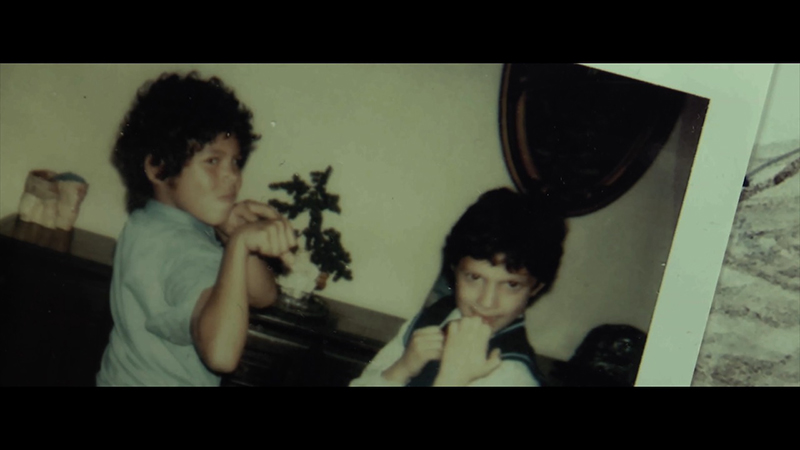
An award-winning documentary shot in Detroit, and about Detroit, makes its Detroit debut this month. Sons of Detroit (2025) is directed by Jeremy Xido, a Detroit-raised actor, performer, and filmmaker. It’s an honest reckoning with part of the city’s history and a heartfelt story of rekindling.
The film has been making its rounds in the festival circuit after premiering at DOC NYC. Earlier this year, it showed at the True/False film festival, premiered overseas in Istanbul, and earned the Best Documentary Feature award at the Sedona International Film Festival.
Full disclosure — this author’s name, Jack Thomas, appears in the credits. I worked on the set as an intern in 2016. Between fetching catering orders and transporting equipment, I got acquainted with Xido and several of the crewmembers — including co-producer Russell Stewart and key production assistant Justin Kearny.
However, like the central characters in Sons of Detroit, we fell out of touch. So, after a decade, it felt very full circle when I got an email from the film’s producer, Amanda Burr Xido, that she and Jeremy (who is also her husband) were returning to Detroit for the premiere.
A Personal Film
For Jeremy Xido, Sons of Detroit, may be his most personal film to date.
“The last thing in the world I wanted to do was make a documentary that I’m in,” says Xido. “But I feel incredibly fortunate and happy that I did do this, because it has been the most transformative experience in my life.”
The plot: Xido returns to Detroit after more than 20 years of absence. He visits the east side neighborhood where he grew up on Drexel and Chandler Park. He sees the home where he spent a great deal of his childhood dilapidated — and sets out to find his neighbors who once lived in the area, who were like a second family to him.
From the 1970s through the early ’80s, he resided on Drexel with his parents, Michael and Barbara Silverstein. Both doctors, the couple were heavily involved in activism and relocated there from California. It was a working-class neighborhood inhabited predominantly by Black families; Xido was the only white kid on his block.
At the time, Xido’s parents were dealing with marital issues. Xido spent a lot of time at his neighbors’ house, where he was cared for by Myrtis and Jimmy Brown. Xido grew close with the family, especially the couple’s grandson, William “Boo” Phillips Jr.; so close they call one another “cousin.”
Xido attended Detroit Public Schools up until middle school, when his parents pulled him out and sent him to The Roeper School, and eventually they relocated to the suburbs. He wouldn’t see or speak to his second family again for decades.
“Back at the Beginning”
Years later, while touring his performance piece, “The Angola Project,” he suffered a heart attack onstage in Berlin. He was rushed to the hospital. During his operation, he had a near death experience in which he saw a house. It was the home on Drexel that belonged to Myrtis and Jimmy.
“This house more than any place is where I felt safe. Where I belonged,” Xido says during a narrated sequence in the film.
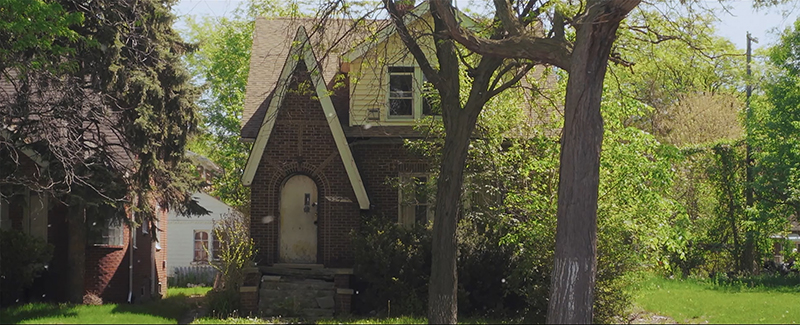
When he awoke from the surgery, he says, “…I had been given a second chance. But something was still rotting, and if I didn’t figure it out, it might actually kill me. And somehow, deep down, I knew the answers were back at the beginning. Back home with my cousin Boo.”
The two finally reunite. As it turns out, they’ve both been gone for about the same amount of time. But while Xido has been traveling the world as an artist, Boo has recently returned from a 20-year prison sentence for a crime he committed when he was just 13.
Xido must reconcile with how he and Boo — two “sons” of Detroit — have been afforded vastly different opportunities in life, due to forces that are larger than them as white and Black men, respectively.
An Unjust History
The film delves into the neighborhood’s history of racism and housing discrimination: in the deed, the original owner of Myrtis and Jimmy’s lot forbid it from being sold to a non-white person.
It also discusses the history of redlining, which shaped neighborhoods in Detroit and its suburbs. Before the Fair Housing Act of 1968, government appraisers deemed neighborhoods with Black residents “hazardous,” making it nearly impossible for Black homebuyers to take out a mortgage.
The film illustrates clearly how racist policy begot racist attitudes among white homeowners: if a Black person bought a home (often for cash) in a white neighborhood, all its residents lost the ability to receive loans, home values declined, and savings disappeared.
Even after its repeal, this policy — among others — had lasting impacts on who lives where, and the distribution of wealth and resources. Today, Detroit is the fourth most racially segregated metro region in the country, per an analysis of Census Bureau data by Governing Magazine.
“That redlining section tends to be revelatory largely to white audiences …who may be relatively well-educated, but are not actually thinking deeply about it,” Xido says. “Whereas most Black audiences are like, ‘Oh yeah. We know that.’ That’s actually where the divide is.”
The Truth About the ’70s
Xido aims to correct the narrative that all was well and fine in Detroit up until the Uprising of 1967 — and everything disintegrated following the “white flight.”
He credits local writer Marsha “Music” Battle Philpot for setting him straight on this; she has a strong presence in the film.
Philpot first met Xido when he was five. She lived nearby with her children. They reconnected by chance on Facebook when Xido was headed to Detroit in 2016. Back then, his plan was to shoot an entirely different film: a screen version of his performance piece “The Angola Project,” inside the Detroit Film Theater, with bits and pieces of footage from around Detroit.
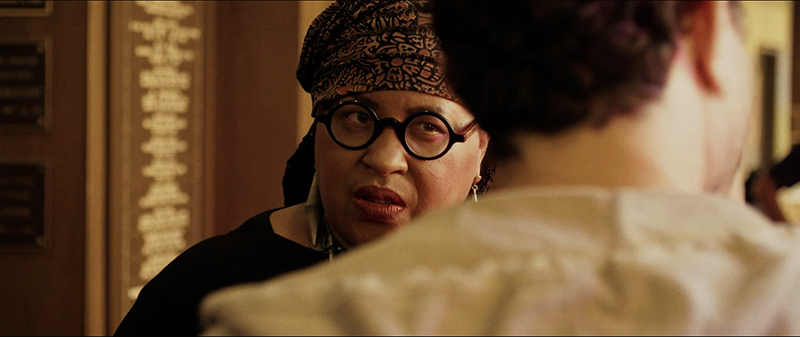
In a pivotal scene, Philpot watches Xido deliver a narration about the city’s history on the DFT stage. Afterwards, she tells him, “What you said up there about Detroit is just wrong.”
Of this moment, Xido says, “The entire idea of the film at that point collapsed. We started looking back at the footage, [and were] like, ‘That’s not the film that needs to be told, and as a matter of fact, it’s a film that can’t be told.’”
He documented the quest to reconnect with Boo and his neighbors during a separate shoot, when he returned in 2018.
The nuanced reality he set out to tell: post-1967, throughout the ’70s, the area on Drexel was a flourishing community occupied by homeowners, mostly Black and working class, who took pride in their neighborhood.
“For a lot of people, it was Detroit’s heyday,” Xido says. “It was a beautiful age in which everything was possible.”
It wasn’t until the 1980s that the community began to experience significant downturn. The automotive industry laid off numerous workers, factories closed, and outsourcing took many manufacturing jobs, leaving an economic vacuum. By 1985, the crack epidemic had hit Detroit.
“It was really a neighborhood on the cusp of destruction,” Philpot tells Xido in the film. “And you were seeing the last gasp of Detroit’s working class, really before it became completely besieged. And that’s what you had the privilege of growing up in.”
A Family Reunion
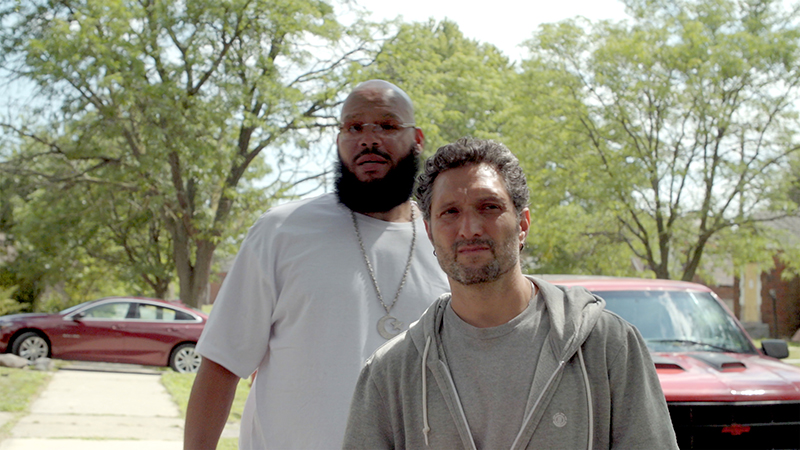
While these larger forces play a role in the film, there’s also the personal: Xido’s quest to reconnect with the neighbors he saw as family — from whom he had become estranged.
On screen, he obtains Boo’s phone number from his cousin Ernest and calls him relatively quickly. In reality, Xido says it took much longer to reach out to the family. He had the number for Pam (Boo’s aunt) for about a year before he was able to dial it.
“I was too scared, because the fear was that maybe she’d be upset at me, or even worse, maybe she’d have no idea who I was,” says Xido.
However, as seen onscreen, Xido was able rekindle his relationships. And that connection has lasted. Xido says he and Boo talk “at least once a week.” He regularly keeps in touch with many of the others he grew up with, including Philpot, as well as James “Mankie” Kershaw and Michella Brown.
“One of the things that I’ve learned after all these years is, even if it’s awkward, or even if it feels like it’s not enough, there is a tremendous power in just showing up,” says Xido, “just to show up, to bring my family, have everybody be in each other’s lives, and to care and to be there.”
Sons of Detroit will screen at the Michigan Theater in Ann Arbor on May 14 at 7:30 p.m. Tickets for the screening start at $17.25. On May 17, the film will screen at the Detroit Film Theatre at 7 p.m. Tickets for the screening are $11.50. For more information, visit sonsofdetroit.com
|
|
|
|
|
|