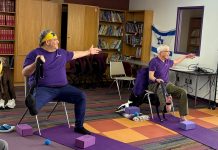
Jim Mangi had been caring for his wife, Kathleen, for about nine years when one night, he found himself lying on a stretcher in the back of an ambulance.
He’d reached the end of a long day, helped Kathleen into clean pajamas, and “absolutely collapsed,” he says.
Kathleen, who’d been diagnosed with early-onset Alzheimer’s at 57, was unable to help; Mangi had to call an ambulance himself.
From the stretcher, Mangi says, he “had to rethink this idea that I can handle it myself.”
Like many caregivers who find themselves “air-dropped” into their new role, Mangi says he’d gotten “the job without any warning, without any preparation, without any training.”
Still, Mangi thought he had everything figured out — that he was fine caring for Kathleen on his own. That assumption lasted until his ride to the ER, where doctors thought he’d had a small stroke.

“Caregivers do not take good care of themselves,” Mangi says, citing a statistic that caregivers often wind up dying before the person they’re caring for. (Percentages vary depending on a caregiver’s underlying conditions, the intensity of care provided, and other factors, but according to a 2018 report by the National Institutes of Health, 18% of spousal caregivers of those with Alzheimer’s or related dementias died first.)
This is something Mangi learned from both personal experience and his work founding Dementia Friendly Services (DFS), the Saline-based chapter of a national network that provides support for those living with dementia — and their caregivers.
Mangi starts from the position that caregiving is “a labor of love.” But he also knows how “draining” and “intense” the work can be — and what a high toll it can exact.
To counteract this pattern, DFS launched a program in which more experienced caregivers are matched with less experienced ones for mentoring and support.
After his ambulance ride, Mangi was able to hire home aides, a privilege he knows not everyone can afford.
Still, he says, throughout his considerable experience, “I’ve never seen any evidence that any one caregiver can get through the entire journey without some help somewhere along the way.”

An SNL Cast Member’s Legacy
Adrian Benedict, grant director for Gilda’s Club Metro Detroit, says caregivers are “the invisible backbone of the health care system.”
The nonprofit, named for Detroit-born comedian Gilda Radner, has made it its mission to “uplift and strengthen people impacted by cancer,” in Benedict’s words.
“We foster and build compassionate communities and do everything we can to break down barriers to care,” Benedict says — and those services (which are “100% free, 100% of the time”) are not only intended for those who’ve been diagnosed with cancer.
As Benedict says, “We believe that if no one should face cancer alone, then that promise has to include caregivers.”
In September 2024, Gilda’s Club was awarded a $200,000 grant by Exhale, The Family Caregiver Initiative, one of 11 respite programs in southeast Michigan to receive funding.
The grant funds a collaborative initiative between Gilda’s and Lori’s Hands, which pairs student volunteers with those suffering from chronic illnesses. Benedict says the initiative is intended “to reimagine respite for caregivers of older adults living with cancer” throughout the area.
Caregivers, Benedict says, frequently carry a heavy load, from managing medications for their loved one to attending appointments, coordinating care, assuming household responsibilities, and providing emotional support.
“They’re oftentimes doing this while managing their entire life on top of that,” Benedict says. “They are working jobs and have families of their own. Because of that, caregivers frequently neglect their own mental and physical health — and that creates a big strain on the entire system.”

As senior philanthropic advisor for The Philanthropic Initiative, which helps funders (including Exhale) increase their impact — and a former caregiver himself — John Tyler says it’s crucial to understand challenges particular to caregivers.
“A lot of times folks have trouble asking for help and feel like the work they’re doing is their natural obligation,” he says.
That can make it difficult “for people to recognize when they’ve reached the point of white-knuckling a problem” rather than admitting — even to themselves — that the burden of care may have become too heavy for one person to assume.
For many caregivers, a great deal of shame might be bound up with this realization. As Tyler says, some have “internalized the notion [that] they shouldn’t need help” or “shouldn’t need to take a break from their loved ones” — and that if they do, they’ve somehow failed.
That’s precisely what makes respite so important, Tyler says: “It allows people to take a break without feeling like they are denying their responsibilities or relinquishing their obligations.”

Together with Lori’s Hands, Gilda’s Club aims to provide a “layered approach to support” across three key services: “intergenerational community dinners, proactive outreach to caregivers who might be disconnected from resources, and in-home visits [from students who] provide practical and social support,” according to Benedict.
The dinners intend to foster connection among caregivers separately dealing with similar issues and levels of stress, which Tyler says “can help you feel like you’re less alone in the world.” Meanwhile, Gilda’s has been reaching out over the phone to “caregivers who may have become disengaged or haven’t accessed [the nonprofit’s] services recently, and [providing] check-ins, resource navigation, and ongoing social support.”
For the second phase of the initiative, piloted by Lori’s Hands, students from Wayne State and other nearby universities make weekly in-home visits to caregivers and their loved ones to provide “practical and social support tailored to caregivers’ specific needs,” Benedict says. That support can include anything from running errands and doing chores to helping caregivers access existing resources.
Benedict says the two-year grant period, which closes in September 2026, “allows us to create meaningful moments of relief and connection and tangible assistance so that caregivers can sustain their own well-being while supporting someone that they love.”
|
|
|
|
|
|