At the closing ceremonies following the last game played at the historic Tiger Stadium on Sept. 27, 1999, 62 former Tigers players in full uniform walked, ran, or were carted from underneath the center field stands to their former positions on the field. Among them were Hall of Famers Al Kaline and U.S. Senator Jim Bunning, along with the two surviving members of Detroit’s first World Series championship team in 1935: 94-year-old Billy Rogell and 89-year-old Elden Auker.
As a clear indication of how much the franchise and fans revered him, the first former player out of the tunnel was 45-year-old Mark Fidrych. Wearing his familiar number 20, he raced to the pitcher’s mound, dropped to one knee, manicured the hill as in days gone by, and then pulled out a plastic bag from his back pocket, filling it with sacred Tiger Stadium dirt. Earlier that day, he’d told UPN 50’s Tim Swore, “I’d love to have that [mound] in my yard.”
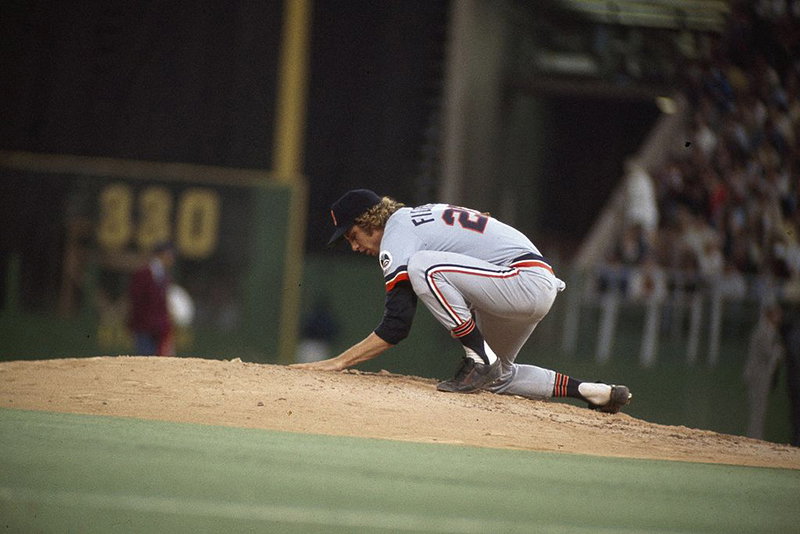
It’s been 50 years since that bicentennial summer of ’76, when the tall and lanky 21-year-old pitcher with long, curly, blonde hair — nicknamed “The Bird” after television’s Sesame Street character — became a beloved Detroit folk hero while packing stadiums across the country. Fans were captivated by his unbridled enthusiasm and antics, which included manicuring the mound before every inning, talking out loud to himself, aiming the ball like a dart, nervously strutting around between outs, and running to and from the dugout.
That season, the Northborough, Massachusetts, native started the All-Star game in Philadelphia and was named the American League Rookie of the Year. Sadly, The Bird was a shooting star whose career was suddenly shortened in 1980 due to injuries before he died in a tragic accident on his Massachusetts farm in 2009.
“His story was incredible, spontaneous, and unpredictable,” says Jim Hawkins, the Tigers beat writer for the Detroit Free Press during Fidrych’s career and the co-author of the pitcher’s unauthorized biography, Go Bird Go! (Dell). “I never saw anything like it in my almost 60 years of covering baseball. Of all the seasons I covered, including the Tigers’ 1984 world championship year, 1976 was the most memorable for me for one reason: Mark Fidrych.”

The Birth of The Bird
Drafted out of high school (Worcester Academy) by the Tigers in the 10th round (232 overall) of the June 1974 amateur draft, Fidrych first reported to the Tigers’ rookie-level minor-league team in Bristol, Virginia — along with future 1984 World Champion Lance Parrish, who had been a first-round pick that year.
“His personality stood out right away,” Parrish says. “He was very outgoing, energetic, always smiling, laughing, and he was a lot of fun to be around. The stuff he did on the mound was genuine, and he did it everywhere. He was primarily a sinker and slider guy with great command, and he kept his pitches down in the zone almost all the time. He was the happiest go-lucky guy you would ever run into, but when he crossed that white line, he was all business. He was a competitor above all else.”
In just his second minor-league year, Fidrych quickly advanced to Triple-A Evansville, where he finished with a 4-1 record and a 1.58 ERA that earned him a non-roster invitation to the Tigers’ 1976 spring training camp. Outside of the organization, media and fans had never heard of him, and to everyone’s surprise, five days before the team went north, Tigers manager Ralph Houk informed Fidrych that he’d made the team with a minimum league salary of $16,500.
Hawkins was as surprised as anyone. “No one expected him to make the team,” he says. “In those days, the Tigers went through young pitcher after young pitcher. I remember that Jim Campbell [the Tigers’ general manager] took Mark to a department store in Lakeland and bought him a sport coat and slacks because all he had were shorts, blue jeans, and a bunch of T-shirts.”
In the first five weeks of the season, Fidrych made just two brief relief appearances, but on May 15, he was given his first start against the Cleveland Indians at Tiger Stadium.
That is when The Bird took first took flight. In front of just 14,583 fans, with the third-string catcher Bruce Kimm behind the plate, Fidrych threw a no-hitter through six innings in a complete game. The two-hit 2-1 victory took just one hour and 57 minutes to finish.
“There was a real buzz in the press box when he had the no-hitter going,” Hawkins says. “It was like, ‘Who is this kid?’ We were just amazed. It was totally unexpected, and it just snowballed from there.”
From then on, The Bird was the word — Tigers fans flocked to the stadium whenever he pitched.

After losing his second start — a complete-game 2-0 loss in Boston — Fidrych reeled off six straight complete-game victories leading up to his national debut on ABC’s Monday Night Baseball. In that June 28 home game against the first-place New York Yankees, Fidrych didn’t just walk off a winner; he emerged a star.
John Hawkinson, 70, who sat in the left center field lower deck, was one of 47,855 in attendance that day. Another 10,000 were turned away. “I attended Game 5 of the ’68 Series, but honestly, I think the Fidrych game was louder than that,” Hawkinson says. “It was just so electric.”
Yankees first baseman and 1976 All-Star Chris Chambliss had no hits that night — striking out twice to The Bird. “Fidrych was a fun guy to watch but not a fun guy to face,” he told Hour from his Atlanta home. “No one had that kind of enthusiasm on the mound that I had ever seen. He looked like he was having fun out there. He had great stuff, movement and location, worked fast, and he knew how to pitch.”
That night, Fidrych beat the Yankees 5-1 with a complete game seven-hitter. After the game, the electrified crowd would not leave and loudly chanted in unison, “We want The Bird!” Several minutes later, Fidrych came out of the dugout for a curtain call while doffing his cap — overcome with emotion as the crowd roared.
“I’ve been in baseball 35 years, and I have never in my life seen anything to equal this,” said Monday Night Baseball color commentator Bob Prince to millions of viewers across the country.
Suddenly, Fidrych became a national phenomenon. Tigers fans bought “The Bird’s the Word” buttons and Fidrych T-shirts, while local radio stations played the 1963 hit “Surfin’ Bird” by the Trashmen.
“On the road, he was like a rock star,” Hawkins says. “GMs from other teams would call Jim Campbell begging that The Bird would pitch in their ballparks. Girls would climb onto the team bus hoping to get a kiss, and outside of his hotel room, there would be girls and reporters. I felt sorry for him.”
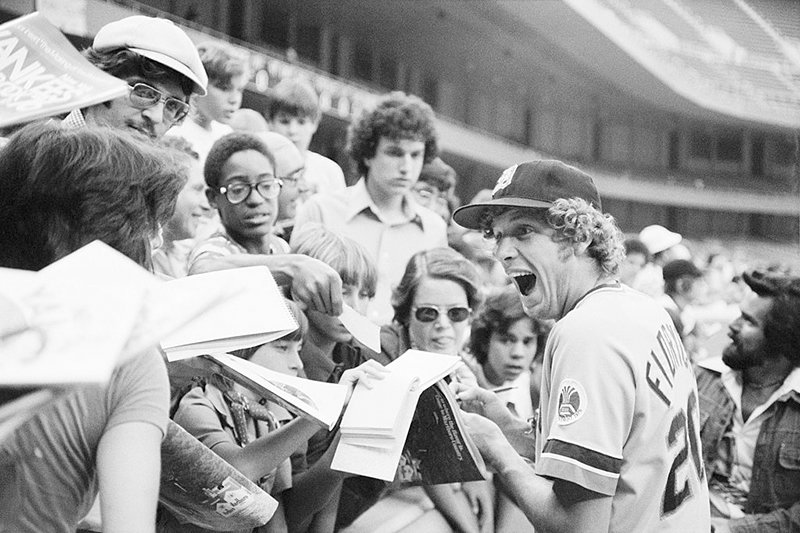
Campbell assigned pitcher John Hiller to mentor Fidrych, and his locker was next to the rookie’s. “When we returned from road trips, there were bags and bags of fan mail,” Hiller says. “It was unbelievable what he went through. It was a lot for a young guy. Suddenly he’s this big celebrity, but he never changed. He was so great with the fans. Mark was the most genuine person I ever met in my life.”
In his next start, Fidrych threw a complete-game four-hitter to defeat Baltimore 4-0 at Tiger Stadium before 51,032 fans. Ten days later, he was the starting pitcher in the All-Star game, where he took the loss after giving up two runs in the first inning.
Fidrych finished the year with a 19-9 record. He was also the league leader in ERA (2.34) and complete games (24), the A.L. Rookie of the Year, and the runner-up for the A.L. Cy Young Award. Meanwhile, despite the Tigers’ fifth-place finish with a 74-87 record, Tiger Stadium attendance had increased by 38%, largely due to Fidrych, who attracted more than 50,000 fans in three starts. When he pitched a home game, the Tigers averaged 33,649 fans compared to 13,893 when he didn’t pitch.
In the final weekend of the season, the Tigers reportedly gave Fidrych, the game’s most underpaid player, a bonus estimated at $34,500. Without using an agent, Fidrych signed a new three-year contract. The terms were not disclosed, but reportedly, he was to be paid approximately $50,000 in 1977.

The Bird Falls to Earth
Sadly, Fidrych became a one-year wonder. While playfully shagging balls in the outfield at spring training the next year, he injured his knee and required surgery. He returned to the mound on May 27, appeared on the covers of Rolling Stone and Sports Illustrated, and had an impressive 6-2 start.
But in July, he suffered an arm injury that was diagnosed as tendinitis.
He would never be the same.
For the next several years, Fidrych struggled to come back from his arm injury and would have only 19 more major-league starts throughout the 1980 season, posting a record of 4-8. He won his final major-league start at Toronto on Oct. 1, 1980, but was pulled after five innings.
Finally, on Oct. 5, 1981, the Tigers released the 27-year-old.
“Mark Fidrych always will retain a spot in the hearts of all those connected with the Tiger organization and fans throughout Michigan and the entire nation,” Tigers president and GM Jim Campbell said to the Detroit Free Press.
In a statement issued through the Tigers, Fidrych said in part, “Most of all, I want to thank all the fans. They were great. It was a great feeling to step on the field and know they were behind me whether I was up or down. … The Tigers have done everything they possibly could do.”
Fidrych was later signed by the Red Sox, playing for Triple-A Pawtucket in ’82 and ’83 until he was released again.
After his retirement, Fidrych returned to Northborough, where he purchased a 107-acre farm, became a licensed commercial truck driver, and married his wife, Ann, in 1986. The year prior, he’d discovered that his arm injury was actually a torn rotator cuff. The couple’s only child, Jessica, was born in 1987.
On April 13, 2009, he died tragically while working underneath his truck on the farm. Reportedly, more than 1,000 mourners paid their respects at the visitation; some waited for more than three hours.

Today, Ann and Jessica continue to honor his memory through the Mark Fidrych Foundation, whose mission is to “enhance the lives of children and adults with disabilities and/or special needs through and with a focus on sports and sports education.”
Appropriately, near the end of Fidrych’s funeral service, mourners sang “Take Me Out to the Ball Game.” In the summer of ’76, he took thousands there, where they celebrated The Bird and America’s pastime.
Words About The Bird
“A lot of opposing players didn’t like his antics on the mound. They thought he was showing them up, but he wasn’t. He was so genuine. Everything about him was real; there was no pretense. He was a kid who had pumped gas in Northborough, Massachusetts, who liked rock and roll.”
—Jim Hawkins, the Tigers beat writer for the Detroit Free Press during Fidrych’s career
“I attended Game 5 of the ’68 Series, but honestly, I think the Fidrych game was louder than that. It was just so electric. I think one of the reasons Fidrych was so loved here is because he was a blue-collar guy who came out of nowhere to a blue-collar town and just performed every day.”
—John Hawkinson, 70, who sat in the left center field lower deck
“He had this unabashed youthfulness, an unrestrained joy about him that was so different before he became a tragic hero. Mark was honest, forthright, fun-loving, and unpretentious. And even during his comeback struggles, people still loved him, and they remembered the joy he brought them. He never complained. He never blamed anybody. He said, ‘That’s just life.’”
—Eli Zaret, former WDIV sports anchor
“Mark is special. He was more than just a great pitcher. He brought a breath of fresh air to the entire game of baseball when it was sorely needed.”
—Jim Campbell, Tigers president and GM, to the Detroit Free Press when Fidrych was released from the team
“Fidrych was the greatest thing I ever saw in the major leagues.”
—Rusty Staub, Fidrych’s former teammate and a 23-year MLB veteran, in an ESPN documentary in 2000
This story originally appeared in the June 2026 issue of Hour Detroit magazine. To read more, pick up a copy of Hour Detroit at a local retail outlet. Click here to get our digital edition
|
|
|
|
|
|