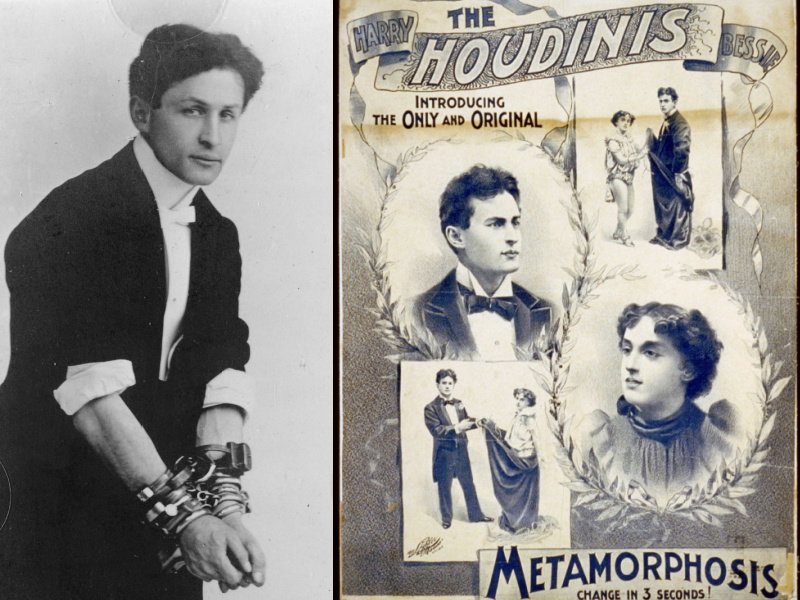
Although he seemingly escaped death numerous times while shackled and submerged in water during his stunts, the world-renowned illusionist Harry Houdini failed to perform any death-defying tricks when he passed away at Detroit’s Grace Hospital 100 years ago this Halloween.
In what would be his final appearance, on Sunday, Oct. 24, 1926, the 52-year-old Houdini — born Erik Weisz in Budapest and raised in Wisconsin — performed a three-act, two-and-a-half-hour show before an audience of 1,400 at the Garrick Theatre in downtown Detroit.
Unbeknownst to the crowd, Houdini had ignored doctors’ orders and performed in extreme pain with a 104-degree temperature.
Two days earlier, before a show in Montreal, a college student who had challenged the magician’s claim of being able to endure stomach punches hit Houdini twice before he could brace for the blow.

Following his Detroit show, Houdini returned to his room at the Statler Hotel, where a physician attended to him. The same physician later admitted him to Grace Hospital.
Doctors diagnosed Houdini with a ruptured appendix. Major newspapers throughout the country published updates on his one-week hospitalization as his condition worsened.
The day after his hospitalization, the Detroit Free Press reported that Houdini had told doctors, “I’ll get out of this like I get out of other things.” However, three hours before he died on Halloween at 1:30 p.m., he said, “I guess I’m all through fighting.” The cause of death was “diffuse streptococcic peritonitis resulting from a ruptured appendix.”
Houdini was embalmed at the William R. Hamilton Funeral Home a few blocks away at 3957 Cass Ave. The building still stands, although it no longer functions as a mortuary.
The next day, his widow, Bess, accompanied the body on the Detroiter train from Michigan Central Station to New York City, where the couple lived in Harlem. More than 2,000 mourners attended Houdini’s funeral on Nov. 4, 1926. He was buried in Queens, New York, at the Machpelah Cemetery. For 10 years after Houdini’s death, Bess held an annual seance on Halloween in an attempt to establish contact with him.

According to Jeremy Dimick, the director of collections and curatorial at the Detroit Historical Museum, Houdini performed in Detroit 19 times between 1894 and 1926.
“When Houdini first came to Detroit, he was doing card tricks, close-up magic, and other sleight of hand, but when he returned to the U.S. in 1905 after becoming world famous in Europe, he was also performing exciting shackled escapes in public places to publicize his appearances,” says Dimick, who regularly gives talks about Houdini in Detroit.
“He was an enormous celebrity 100 years ago, and there is still a public fascination with him,” he says.
One of Houdini’s most celebrated stunts occurred on Nov. 27, 1906. To help publicize his two-week engagement at the Temple Theater, he jumped off the original Belle Isle Bridge into the icy Detroit River while manacled by two police handcuffs. (Newspaper reporters held the keys.) He soon emerged with his hands free to the cheers of bystanders. To promote a 1922 appearance at the Madison Theatre, Houdini was suspended in a straitjacket upside down from the top of the still-standing Fyfe Building on West Adams before he escaped.
The three buildings associated with Houdini’s final days have all been demolished: the Garrick Theatre, located at 1122 Griswold, in 1928; the Statler Hotel at 1539 Washington Blvd., which overlooked Grand Circus Park, in 2005; and Grace Hospital at 4160 John R, where the Detroit Medical Center now stands, in 1979.
Jeremy Dimick will present a lecture at the Detroit Historical Museum on Thursday, Oct. 29, at 6:30 p.m. to honor the 100th anniversary of Houdini’s passing.
This story originally appeared in the October 2026 issue of Hour Detroit magazine. To read more, pick up a copy of Hour Detroit at a local retail outlet. Click here to get our digital edition.
|
|
|
|
|
|