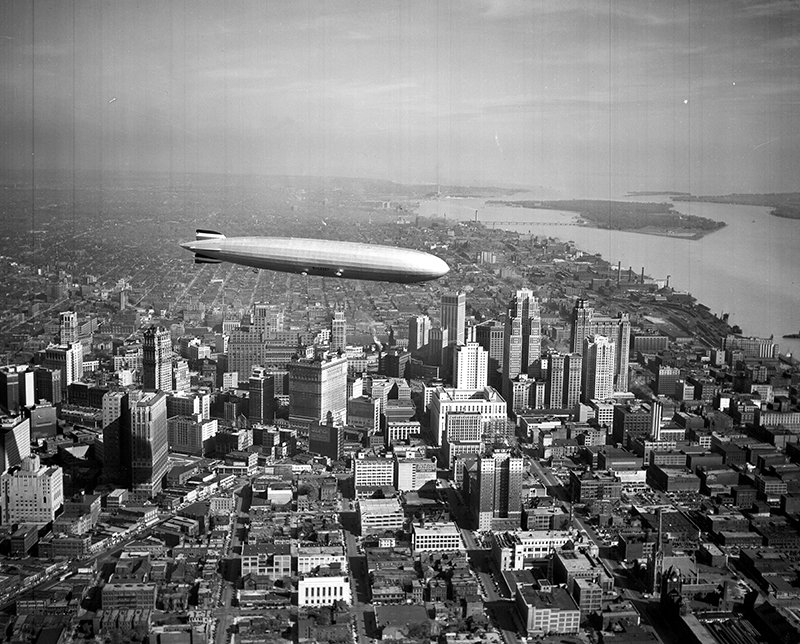
Around lunchtime on Oct. 26, 1933, hundreds of workers and shoppers poured into the streets to witness the giant, world-famous German airship Graf Zeppelin (LZ 127) make a majestic flyby over downtown Detroit.
The 776-foot-long rigid airship — a powered, steerable aircraft inflated with gas, with a framework surrounding individual gas cells — traveled to the United States primarily to appear at the “Century of Progress”-themed World’s Fair in Chicago, where it had stopped earlier that morning. As reported, it flew from Chicago following U.S. 12 (Michigan Avenue), eventually passing above Greenfield Village and the Ford Rouge plant before pivoting around the Penobscot Building, over Grand Circus Park, and above the Detroit News building.
As reported by the Detroit News, “The watchers high in the office buildings were rewarded when the Graf passed over the river toward Windsor, throwing its huge shadow on its glistening waves.” The Graf Zeppelin then headed to Akron, Ohio, before returning to Germany.
The Detroit flyover became controversial as Adolf Hitler’s newly installed Nazi regime used the airship for propaganda purposes. The tricolor German flag appeared on the starboard fin (pictured above) while the Nazi swastika flag was emblazoned on the port fin.
First launched in 1928, the Graf Zeppelin carried 20 passengers in the gondola underneath the airship but was retired just over a month after the LZ 129 Hindenburg airship disaster on May 6, 1937, at Lakehurst, New Jersey, that killed 35 of the 97 passengers and one of the ground crew. Among those killed was Captain E.A. Lehmann, who had piloted the Graf Zeppelin during its flight over Detroit.
During its nine-year career carrying passengers, mail, and freight, the Graf Zeppelin flew more than a million miles on 590 flights.
This story originally appeared in the October 2026 issue of Hour Detroit magazine. To read more, pick up a copy of Hour Detroit at a local retail outlet. Click here to get our digital edition.
|
|
|
|
|
|