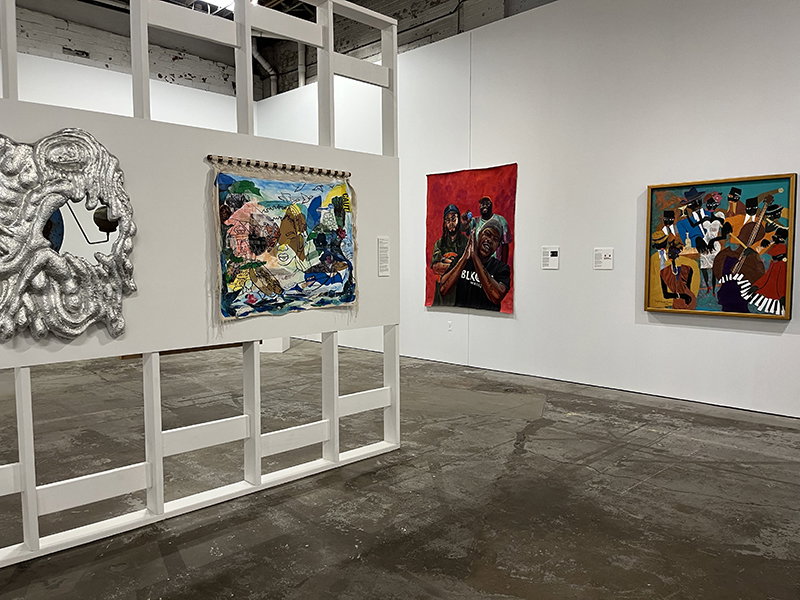
The Museum of Contemporary Art Detroit is closing out its 20th year with an anniversary show. 20 Years of MOCAD: A Practice of Multiplicity features works from over 80 artists that have previously exhibited at MOCAD over its two decades. The four-part exhibition represents homegrown talent, as well as artists based in other states and internationally.
In Their Own Words
At a media preview on Nov. 6, Hour Detroit had the chance to hear several featured artists talk about their works. Here are a few of the art pieces you can see at 20 Years of MOCAD, as described by their creators.
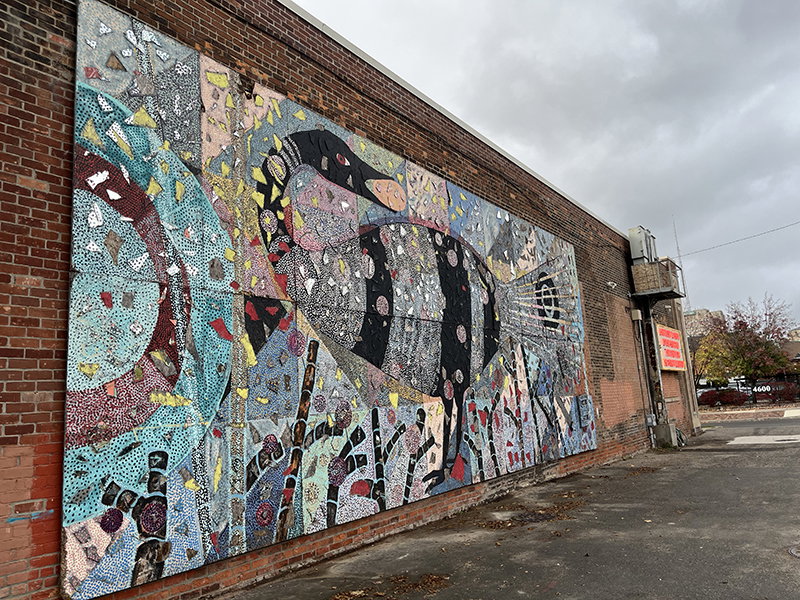
Sankofa Bird by Olayami Dabls
Of the gigantic bird depicted in the painting, Dabls explains, “It has an egg in its mouth to remind you how important life is. The mirrors on it are to remind you’re constantly looking at yourself, although you’re looking at yourself through my art.” Dabls’ retrospective exhibition Detroit Cosmologies took place at MOCAD this past spring.
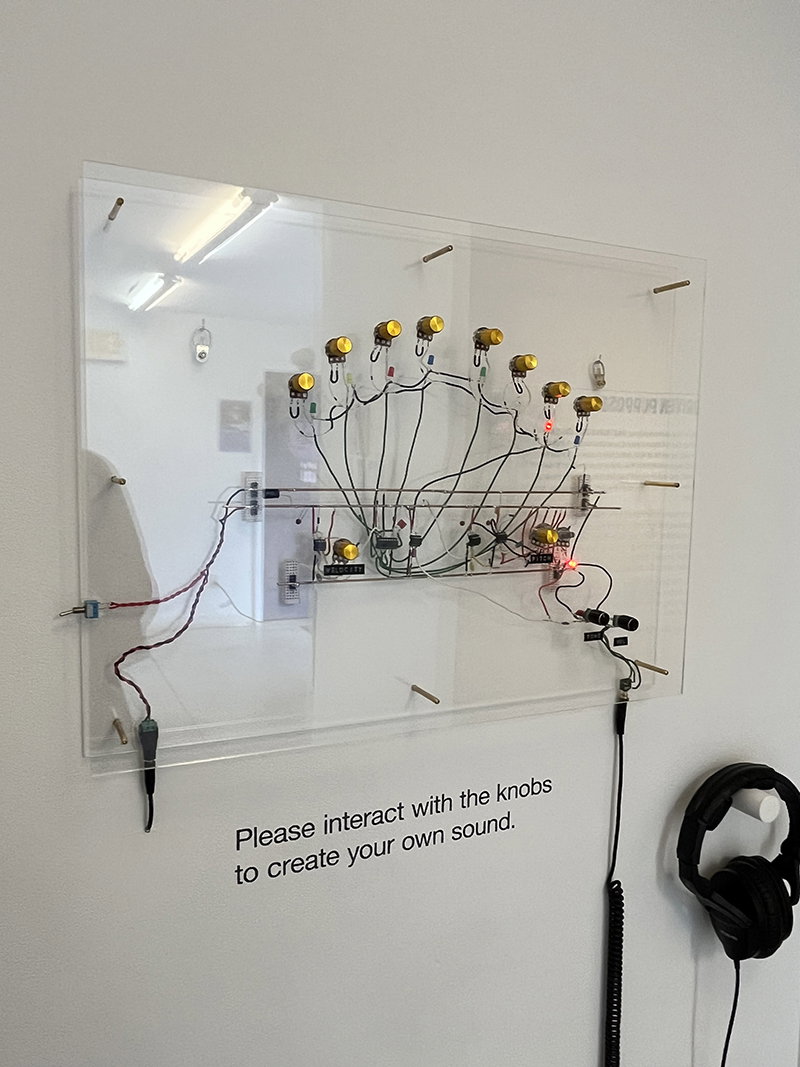
SEQ_1 by Vanessa Reynolds (AKA Venusloc)
The sculpture invites the museum patron to experiment with sound by turning different knobs (tone, volume, pitch, velocity) on an eight-step sequencer that generates rhythms and an Atari Punk Console. “Essentially, it’s a way to lay bare something that I feel as a musician,” Reynolds says.
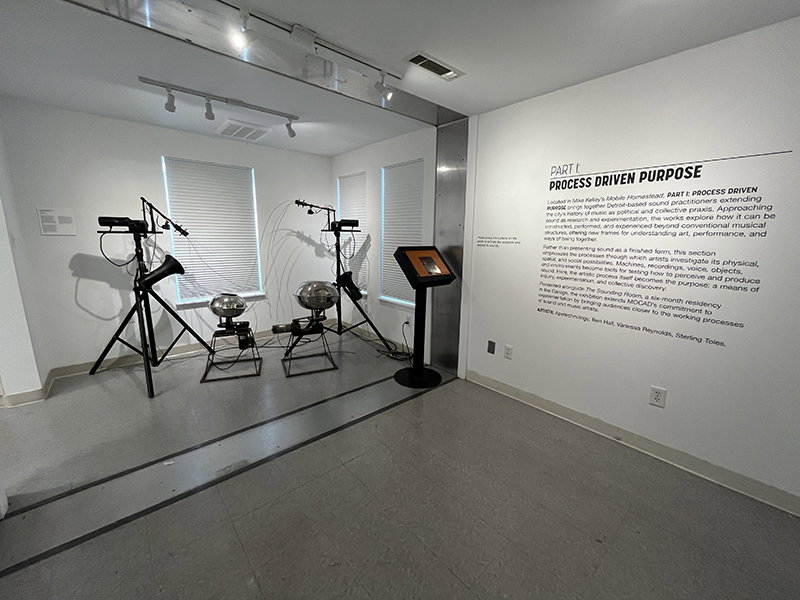
Whip Salad by Aptechnology (Leith Campbell, Chip Flynn, and Brad Ballard)
The contraption originally appeared at MOCAD in 2012 as part of its Visions in a Cornfield exhibition. Of the Aptechnology’s body of work, member Leith Campbell says, “We’re an obsessive lot, so we just kind of relentlessly go at a problem until it’s solved — even though all of our problems are self-created.”
s(h)elves? By Sterling Toles
Toles first exhibited this piece at MOCAD in 2022. It incorporates a potential transformer, which he obtained through a friend working at DTE’s Warren Service center. “It distills a great amount of electrical energy into energy that is able to go to homes and small businesses,” says Toles. “We are all, in a sense, potential transformers that have access to the infinite amount of energy that exists in the world, and through our own processing of our own experience, we’re able to give that energy, which I feel is essentially love, to everybody that that we encounter.”

ROAD WORK: Heart Work Ahead by Bryce Detroit
This sign is part of Bryce Detroit’s series Road Work, a public art project which reinterprets street signs as catalysts for social change. Of the message behind this piece, he says, “Foundational work that we all have to do is the designing, cultivating of the self-image that will render our most divine self-actualization on earth.”
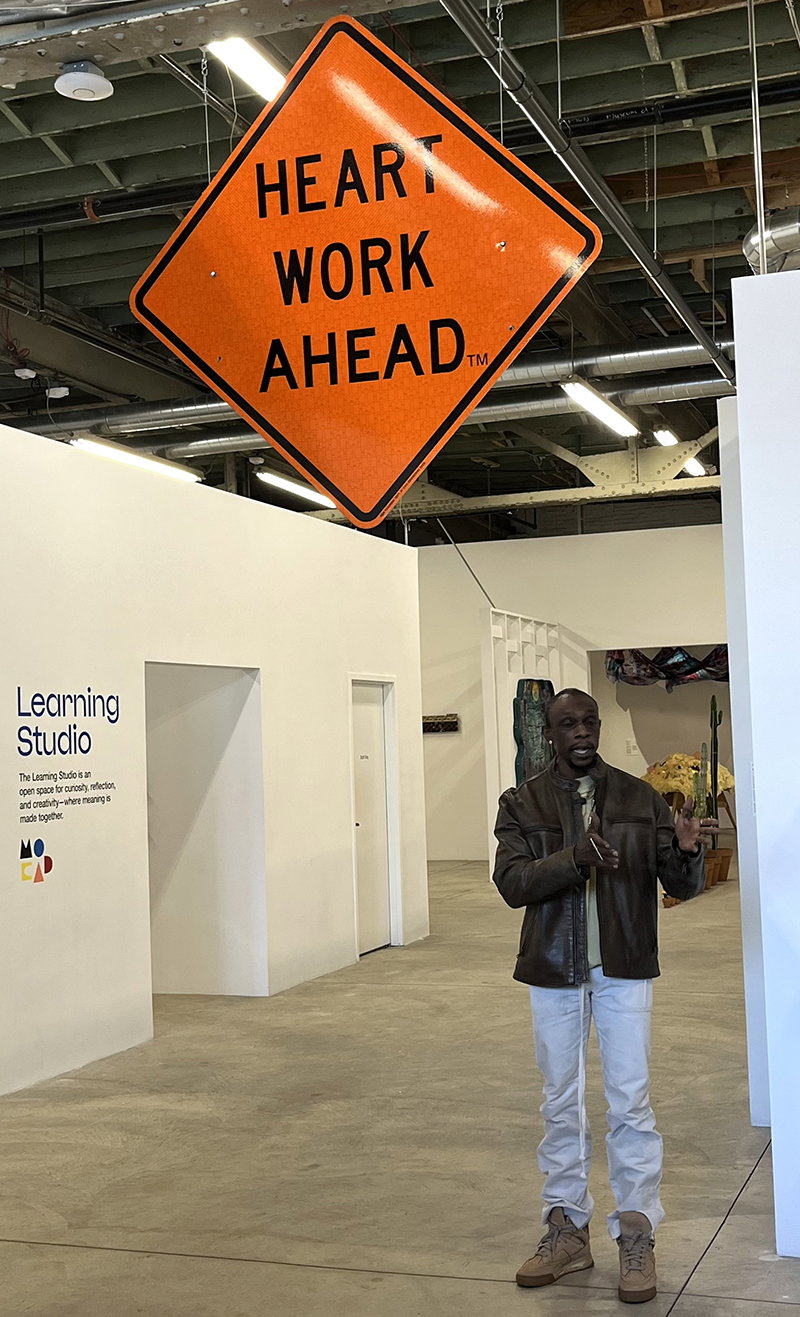
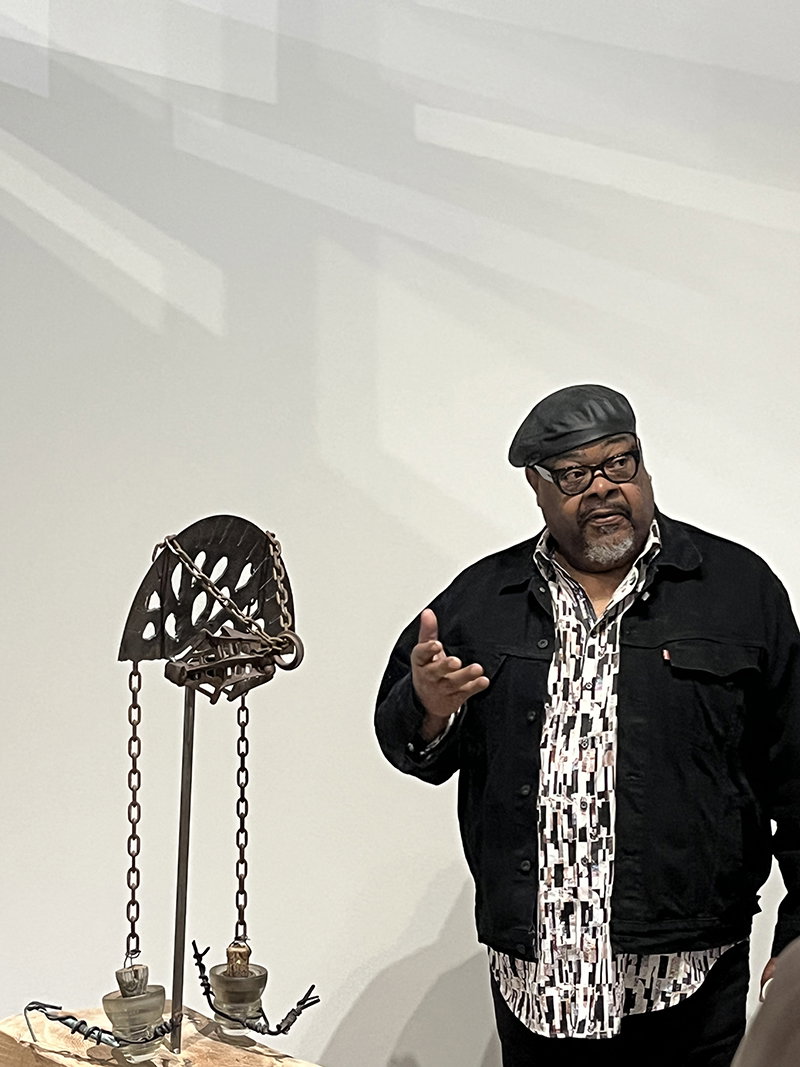
Yes Chef by M. Saffell Gardner
This sculpture is made entirely from found pieces. It started from one scrap that Gardner found. “To me, it looks like a muzzle,” he says. “It reminded me of what they would do to slaves that cooked in the kitchen. They would have leather or metal, so they wouldn’t be able to eat the food or spit into the food.” He calls the piece a tribute to “to chefs of color, mainly African American chefs.”
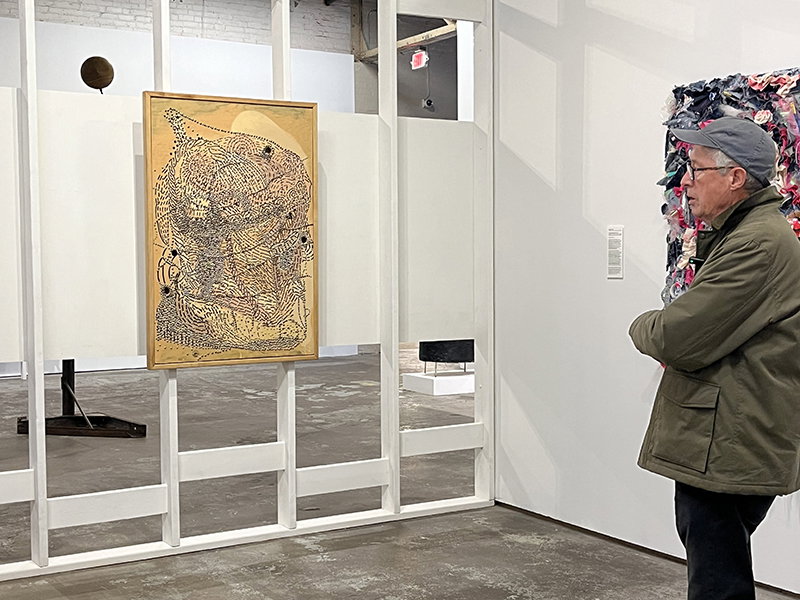
Head on a Plate by Jim Chatelain
The abstract image that loosely resembles a head is composed of hundreds of Phillips-head screws driven into a sheet of plywood. When describing his way of working on the piece, Chatelain says, “It’s a process of…using screws and markers as a drawing tool to create an image. It is arbitrary, maybe, at the start, but as you work through it, I kind of find the painting.”
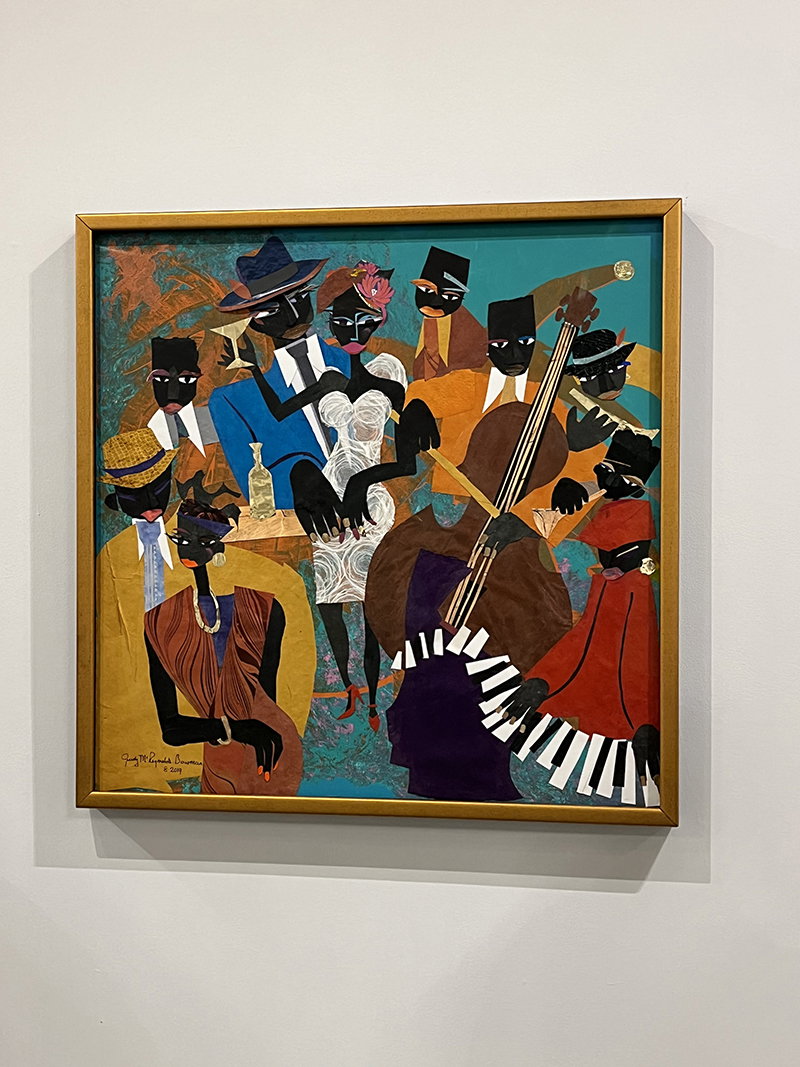
Detroit Swag by Judy Bowman
Bowman, who created this collage piece, was born and raised on Detroit’s east side. Her family lived in the Black Bottom neighborhood before it was demolished. “My family were dressers,” she says. “I travel around the country, and you can tell a Detroit person by the way they dress. I wanted to show that in my work.”
313 Kings of the East by Sydney G. James
James is a painter and muralist, responsible for numerous public works around Detroit including the iconic Girl with the D Earring on the Chroma Building along East Grand Boulevard. This painting depicts three artists from Detroit’s east side, where James is also from. “The lesson we learn on the East Side is we make our own way,” she says. “[These three artists] all make their own way in their own collectives, and they all have their own friends, their own experiences that they give the city and really, the world.” 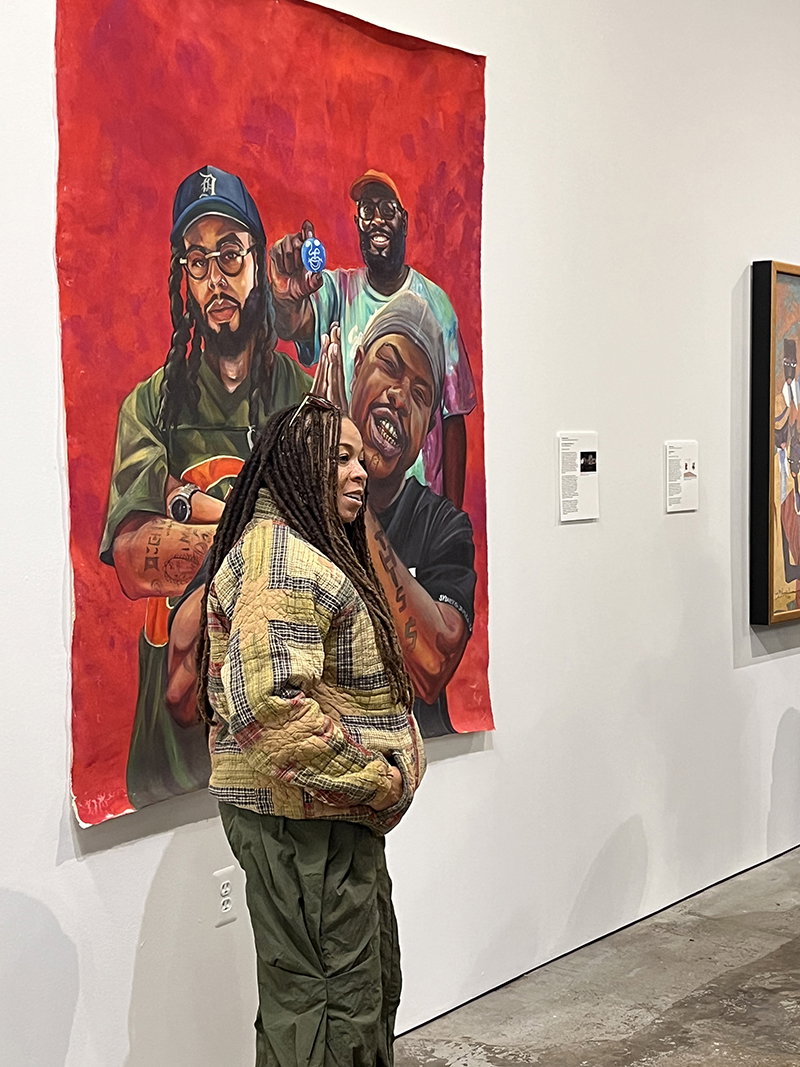
Moth (Pink) by Kathryn Brackett Luchs and Michael Luchs
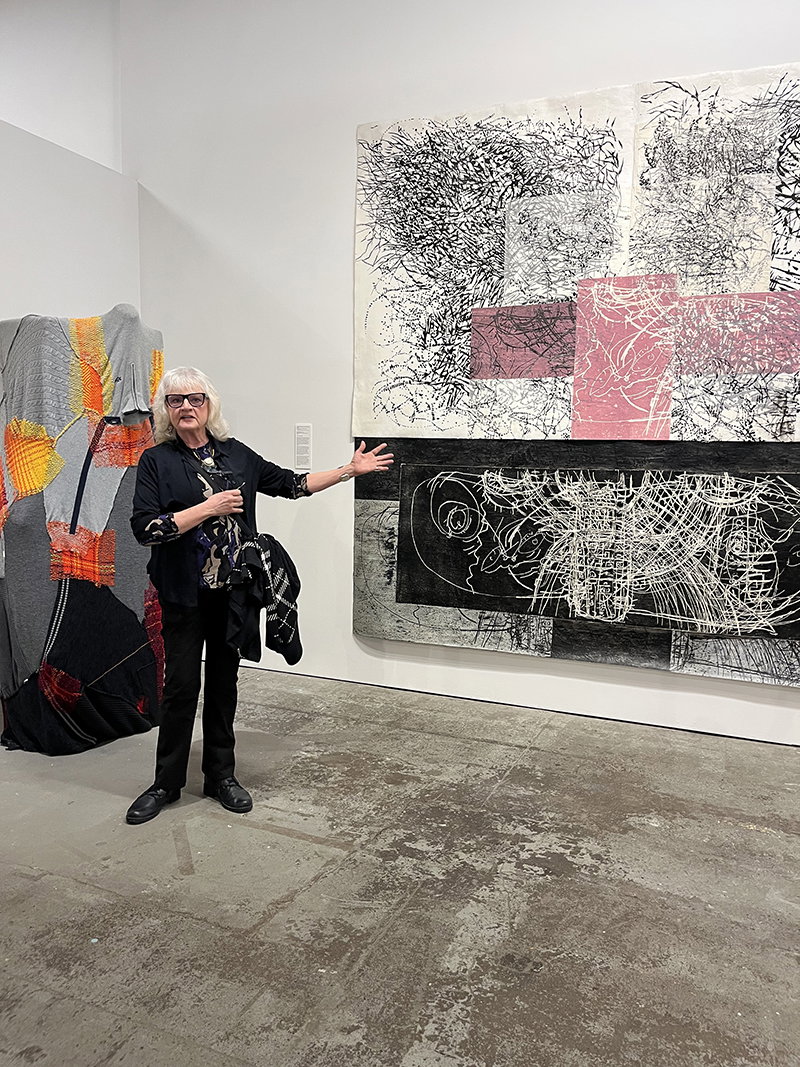
Kathryn Brackett Luchs created this piece with her late husband, Michael, who died in 2021, the same year it was completed. The two had an interesting relationship — they were married twice, and shared studios together over the years. “Even though we both have our own bodies of work, this represents a lot of history,” Kathryn says.
Detroit Artists Discuss the Legacy of MOCAD
MOCAD opened in 2006, though the idea to create a contemporary art museum in Detroit was conceptualized about a decade earlier by longtime Detroit Free Press art critic Marsha Miro, gallerist Susanne Hilberry, and philanthropist Julia Reyes Taubman.
Though it has hosted exhibitions and music performances from big names around the world, the museum has also given a platform to local artists. For instance, mixed media artist Judy Bowman debuted her first ever solo museum exhibition at MOCAD in 2022. The Detroit native retired 14 years ago after a long career as an educator. In her retirement, she was able to fully devote the time she wanted to her art.
“[MOCAD] means a lot to me, because I wanted to be an artist from when I was small, but life got in the way,” Bowman tells Hour Detroit. “I want to say to other people who have a talent or a gift to go out there and do it. …It’s never too late to do what you what you’re put here on earth to do.”
Detroit-based fine artist M. Saffell Gardner’s first show at MOCAD was in 2012, when he co-curated Visions in a Cornfield with his collective Ogun, collaborating with Destroy All Monsters and Apetechnology. Gardner says in recent years, the museum has shown a commitment to the community through educational initiatives — such as free field trips for the Detroit Public School District. This work is important, he says, because “art teaches kids a different way to think.”
In its years of operation, the museum has not been above criticism or controversy. In 2020, staff allegations of a toxic workplace and racism triggered an internal investigation that resulted in a director’s firing.
“Over the past 20 years, there has been a lot of critical conversation about the way MOCAD was showing up and actually being of service to the city,” says artist Bryce Detroit, whose first MOCAD exhibition was Brood in 2021. “But within the last 10 years, there has been a very clear, explicit intention by the leadership for MOCAD to not only represent Detroit in name, but actually be a place that is intentionally uplifting, centering Detroit cultural production.”
Schedule
On display through March 21, 2027, in Mike Kelley’s Mobile Homestead:
- Part I: Process Driven
On display through April 4, 2027 in the Julia Reyes Taubman Building:
- Part II: Artist As Architect(Gallery 1 )
- Part III: Detroit As Material (Central Gallery)
- Part IV: A Practice Of Multiplicity (Woodward Gallery)
MOCAD opens at 11 a.m. Wednesday to Sunday. It closes at 8 p.m. on Thursdays and Fridays, and at 5 p.m. on Saturdays, Sundays, and Wednesdays. For more information, visit mocadetroit.org.
|
|
|
|
|
|