Huda Fahmy’s 10-year-old son is her “biggest fan,” says the graphic novelist.
“He’ll have my books all lined up on his bedside as he’s going to sleep….[then] you’ll see him at breakfast, and he’s just eating cereal and reading my books,” she says with a laugh.
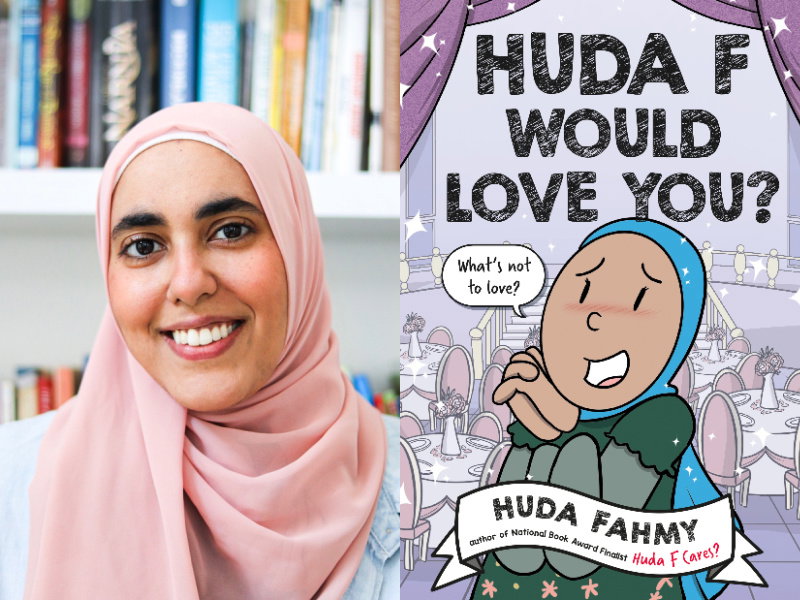
Now he has a new book to add to his stack: The fourth and final installment of Fahmy’s Huda F series, Huda F Would Love You?, was published last month, and Fahmy celebrated its release with a book signing and Q&A on Oct. 28 at Green Brain Comics in Dearborn.
The series, which is aimed at readers 12 and up, follows a young girl as she grows up and grapples with her identity and her place in the world. Each book sports a punny title that hints at both the humor and the self-determination embodied by its protagonist. The second book in the series, Huda F Cares?, was a finalist for a 2023 National Book Award for Young People’s Literature; the other titles have been widely critically acclaimed.
Fahmy, who shares a name with her protagonist, admits with a laugh, “I did shoot myself in the foot a little bit.”
Readers tend to assume that everything that happens to fictional Huda has also happened to real-life Fahmy—which it hasn’t, she insists.
“There are some similarities, but really, for the most part, she is very much her own character.”
Still, like real-life Fahmy, fictional Huda grows up in Dearborn alongside her five sisters. (When she started writing, Fahmy says, she “wanted to honor my sisters,” but the fictional characters quickly “[took] on a life of their own.”)
Fahmy says, “The whole series is really about Huda being self-aware and introspective about who she is and trying to figure herself out.”
The Evolution of Huda F
The series also traces Huda’s growth: in the first book, she’s a high school freshman who “doesn’t know where she fits in. She doesn’t know how to [meet] all of the expectations that school, society, family, [and] her community” direct her way, says Fahmy.
In the latest book, Huda has finished high school and is looking ahead.
Fahmy, who spent years teaching middle and high school English, says the issues Huda grapples with throughout the series are things that “everyone, really, grew up with.”
Many “young adults who have just graduated from high school…feel that taste of independence,” she says. “Everything they’ve learned and all these lessons they’ve had growing up—they finally get to put it to the test and decide: Is that who I really want to be, or am I just being that because everyone else has told me that’s who I’m supposed to be?”
But Huda’s experience is also a particular one: she and her family are visibly Muslim (she wears her hair covered, for example) in a country riven by prejudice.
“I wanted to fill this gap of representation,” Fahmy says. “A lot of people don’t really get to hear from Muslim Americans who were born here.”
Fahmy was born in Detroit to immigrant parents who spoke Arabic at home.
“When kindergarten and first grade came around, they were like, ‘Oh, you’re going to public school—where nobody speaks Arabic,’” Fahmy says.
So, she says, “I took it upon myself to teach myself English,” and she did that by reading the Sunday funnies—with a dictionary.
“In addition to learning English, I feel like that’s also where I picked up a lot of my sense of humor. Definitely my sarcasm, much to my mother’s joy,” Fahmy says.
She didn’t start drawing until adulthood, but she’s proud of the progress she’s made, which she says is reflected in the progression of the series.
Huda F “has grown just as my art style has grown,” Fahmy says. “It’s a nice little parallel.”
For more information and to purchase the Huda F series, visit hudafahmy.com/books.
|
|
|
|
|
|