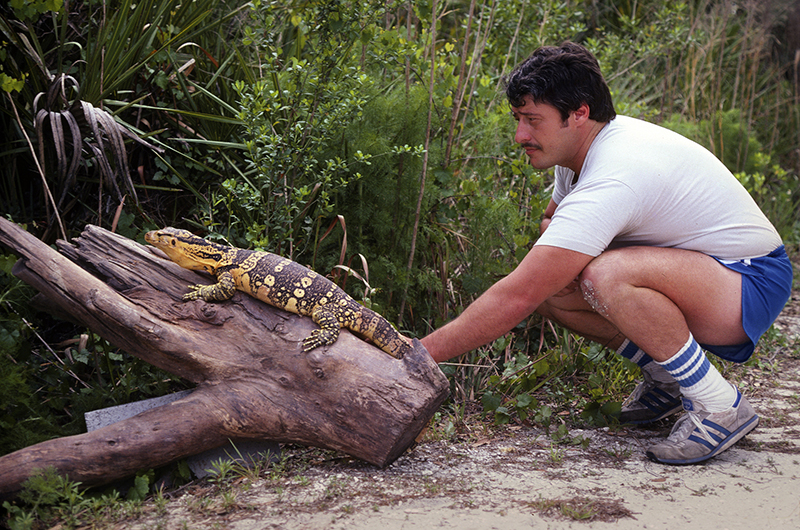
In the new HBO docuseries Monsters of God, a notorious Florida reptile salesman says he’s sold illegal animals to the Detroit Zoo during his smuggling days. But to be fair, he claims they were one of many customers — and he’s not sure the zoo knew the reptiles were illegal.
“I sold illegal animals to every zoo in this country,” said Tom Crutchfield in the series’ Aug. 6 premiere episode. “But whether [the Zoos] knew [the animals] were illegal, I can’t say that for sure.” In addition to the Detroit Zoo, Crutchfield namechecks the New York Zoological Society, Fort Worth Zoo, Gladys Porter Zoo, and Los Angeles Zoo.
Crutchfield was once considered one of the largest reptile importers in the U.S. He was first criminally charged in relation to his smuggling in 1992 and then 1995, but ultimately skirted sentencing. Then, in 1997, he fled to Belize after learning he was the subject of a Justice Department investigation. In 1999, he was extradited and sentenced to 30 days in federal prison after pleading guilty to seven felony counts of conspiracy, smuggling, and violating the Lacey Act. He admitted to smuggling over 200 reptiles into the states.
The Detroit Zoo Responds to HBO
Jeff Sell, the zoo’s director of communications, sent Hour Detroit the following statement in response to Crutchfield’s claim that he used to sell illegal reptiles to the Detroit Zoo:
“We have not seen the series, so we can’t comment on its content, but we can be clear that the Detroit Zoo is strongly opposed to wildlife trafficking in all forms, and we work in collaboration with state and federal agencies to combat wildlife crime. The Detroit Zoo is also a proud partner of the Association of Zoos and Aquariums’ (AZA) Wildlife Trafficking Alliance, a coalition of more than 300 organizations — including all AZA-accredited zoos and aquariums — working together to combat wildlife trafficking worldwide through collaboration, public engagement and collective action.
Wildlife trafficking is a serious global crisis that threatens animals, ecosystems and public health. We are committed to being part of the solution to protect species, advance science and uphold the highest standards of animal care.
The Detroit Zoo adheres strictly to AZA accreditation standards, CITES regulations and international wildlife transfer protocols. Everything the Zoo does is in compliance with wildlife laws and in service to wildlife protection and care. Today, accredited zoos are deeply engaged in fighting wildlife trafficking, rescuing confiscated animals and protecting endangered species globally. Our mission is to safeguard wildlife for future generations, and that commitment guides our work every day.”
An Alligator from Operation Chameleon
The Detroit Zoo’s Holden Reptile Conservation Center (formerly the Holden Museum of Living Reptiles) first opened in 1960. Today, it’s home to about 150 reptiles representing over 70 species — 45% of which are designated as threatened or endangered.
Hour Detroit could not determine by press time whether any are related to those Crutchfield allegedly sold to the zoo. However, in 2019, the zoo adopted a critically endangered Chinese alligator that was previously seized in Operation Chameleon. This undercover operation, conducted in the ’90s by the U.S. Fish and Wildlife Service, led to Crutchfield and other reptile smugglers being convicted. It is the subject of the series’ fourth episode, set to premiere Aug. 27.
How to Watch Monsters of God
Monsters of God is a five-part series from Goode Films, A24, and Central Pictures. Directed by Eric Goode (Chimp Crazy, Tiger King), it chronicles the multibillion-dollar reptile industry. The first episode, “The Fever,” focuses on the rivalry between Crutchfield and his mentor-turned-nemesis Hank Molt. Both were major players in the illegal reptile trade. Subsequent episodes will premiere on HBO Max at 9 p.m. each Thursday.
|
|
|
|
|
|