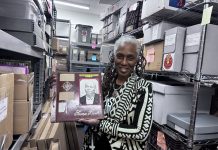
How do you move a revered cultural institution focused on the past into the 21st century and increase attendance? This was a question on the minds of leadership at the Henry Ford Museum and Greenfield Village in Dearborn before Patricia Mooradian was hired in 2000 as vice president of programming and marketing.
“The institution was in an evolving state when I came here,” says the former Taubman Company marketing executive from her office on the second floor of the museum’s Independence Hall replica. Steve Hamp, the Henry Ford Museum and Greenfield Village’s president and CEO at the time, had recognized Mooradian’s ability to bring new ideas to the table and wanted her to build on what he and Harold Skramstad, CEO from 1981 to 1996, had started.
Known as a high-energy, entrepreneurial visionary, Mooradian spearheaded strategic plans to transform the private nonprofit institution, which included creating new exhibits, broadening education initiatives, and widening its appeal nationally with clever marketing and rebranding. She was promoted to chief operating officer within months and to president and CEO in 2005.
Mooradian first led a market analysis that included an in-depth exploration with staff and guests by asking, “Who do you think we are, and what do we have?”
“People out of state called us ‘The Ford,’ and in state people called us ‘The Village,’” she says. “I remember one person said, ‘I went there with my fourth-grade class, but I don’t need to go back there because nothing has changed.’ Well now so much has changed.”
In her first year with the institution, Holiday Nights in Greenfield Village was introduced, and in 2003, the Henry Ford Museum and Greenfield Village were rebranded as The Henry Ford while the process of introducing updated and new exhibits continued.
As the first female and longest-serving CEO in its nearly 100-year history, the Pennsylvania native and graduate of Texas Christian University (Bachelor of Fine Arts ’82) has continued the transformation of the 250-acre campus consisting of the Henry Ford Museum of American Innovation and more than 90 historic structures at Greenfield Village.
She is responsible for an annual operating budget of $92 million, 1,495 full- and part-time employees, 403 volunteers, 26 million artifacts, the Benson Ford Research Center, the Ford Rouge Factory Tour, the Giant Screen Experience (formerly an IMAX theater), and the on-campus public charter high school, Henry Ford Academy.
Under Mooradian’s leadership, several new exhibits have been installed at the museum, including, among others, With Liberty and Justice for All (2006), which displays the Rosa Parks bus; Driving America (2012), an exhibit dedicated to the automobile’s impact on American life; Driven to Win: Racing in America (2021), showcasing auto sports; and the more recent Collections Gallery (2023), a revolving space dedicated to displaying The Henry Ford’s own collections.
For the past three years, Mooradian has been working on one of Greenfield Village’s most significant acquisitions in 40 years: the Selma, Alabama, home of Dr. Sullivan Jackson and his wife, which was a safe haven for Martin Luther King Jr. during the planning of the 1965 Selma to Montgomery civil rights marches. The Jackson Home is slated to open this year as part of the celebration of the country’s 250th anniversary.
Another key to making the institution more focused and relevant began in 2007, when Mooradian and her team decided to “tell our story of innovation, which has always been, along with education, the underpinning of our foundation,” she says. “Our mission is to use artifacts and tell the stories of innovation to inspire people to build a better future.” In 2017, the museum was renamed the Henry Ford Museum of American Innovation.
In 2014, Mooradian implemented the institution’s first nationally broadcast television series, The Henry Ford’s Innovation Nation, a 30-minute Saturday morning CBS show that won three Daytime Emmy Awards, ran for 10 years, and helped increase attendance.
In 2018, the institution adopted Invention Convention Worldwide, a global K-12 invention education program and competition that teaches students problem identification, problem-solving, creativity, and entrepreneurship.
“Over 200,000 kids participate, and over 500 winners come here and compete in nationals,” she says. “Those that are judged patent-worthy then get to work with patent attorneys. Thirty-three kids have 33 patents.”
She adds that The Henry Ford also provides approximately 600 curriculum resources for educators at their inHub online platform and that annually, around 200,000 schoolchildren visit the institution.
Mooradian’s impact during her tenure as president and CEO is also obvious when looking at the numbers, despite having to deftly navigate through the Great Recession (2007-2009) and the COVID-19 pandemic.
In 2005, the institution had 1.4 million visitors and generated $53.1 million in revenue, with an endowment of $265 million. In 2025, 1.7 million visitors, $92 million in revenue, and an endowment of $461 million reflected a 21% increase in attendance and a 73% increase in revenue and endowment.
“During Patricia’s tenure, The Henry Ford has raised its visibility and prominence nationally and internationally as one of the preeminent institutions of its kind,” says General Motors President Mark Reuss, chair of The Henry Ford’s board of trustees. “At the same time, it has only increased its relevance and impact on southeast Michigan, all thanks to her vision and leadership. She has been a terrific steward of one of our community’s greatest treasures.”
Mooradian has set the bar high for an eventual successor, not that she has set a retirement date. “I love what I do,” she says. “We have a super-talented team, and the work is inspiring. I’d like to be here when The Henry Ford turns 100 in 2029, by that time, I would have been here almost 30 years, and that’s something that I could never have imagined because when I was first hired, I said that I would give it a year,” she says with a laugh.
Have she and her team started to plan for the institution’s 100th anniversary?
“Believe me, for our 100th, we’ll do something more than just a cake,” she says, smiling.
This story originally appeared in the January 2026 issue of Hour Detroit magazine. To read more, pick up a copy of Hour Detroit at a local retail outlet. Click here to get our digital edition.
|
|
|
|
|
|