The Motor City’s haunted side doesn’t disappear when Halloween ends. In Detroit, dark lore seems to lurk around every corner.
You’ve likely heard about The Whitney, so famously haunted that it named its third floor The Ghost Bar. Its ghouls include owner David Whitney’s spurned first wife, Flora, and their daughter, Grace, who rattles the mansion if you disturb her tea set in the carriage house.
The Masonic Temple may house more than a secret society. Rumors that founder George Mason leapt from the building after his wife left him have led to tales of a specter heading for the roof. (In reality, Mason lived to age 91.)
Storied supernatural spots include Elmwood Cemetery, Historic Fort Wayne, and even the Detroit Public Library — once visited by the city’s resident omen, the Nain Rouge. But the creepiest locales are where history hides beneath your feet.
Have you heard strange noises near the Detroit Institute of Arts’ “Nail Figure,” as nighttime staff have? Have you passed through a cold spot in Orchestra Hall, thought to be the presence of the orchestra’s first music director? If you park on a Belle Isle bridge and honk three times, does a woman in all white appear, beckoning you to follow her? (If so, you probably shouldn’t.)
Some unsettling stories live on as memories in the pavement. When you visit Hudson’s Detroit, you’re close to the site of Stephen Simmons’s hanging, the last public execution before Michigan outlawed the death penalty.
And though crew followed a thorough, respectful reburying process, human remains may still lie beneath Eastern Market, built over the former Russell Street Cemetery.
You may grab a drink with a ghost, like the Western-clad Colonel Philetus Norris at Two Way Inn or a fedora-wearing figure at Tommy’s Detroit. Ask about the phantoms at Nancy Whiskey’s or Cadieux Café.
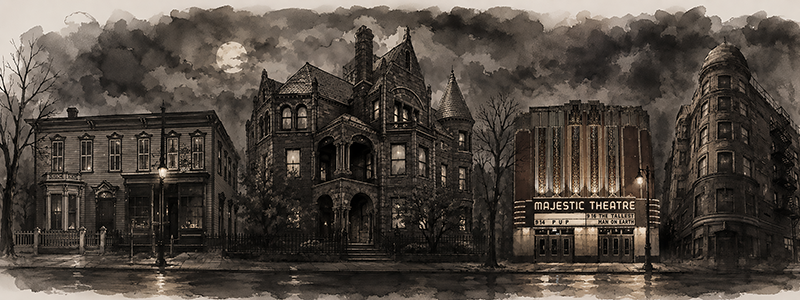
You might witness an apparition at a concert. One at St. Andrew’s Hall has chased guests up the stairs. And a late musician may have made an appearance at the Majestic Theatre. When The Revolution performed there in 2017, they symbolically set up an empty microphone for Prince. A woman took a photo of the microphone, decked with one of Prince’s scarves, and believed she captured the presence of the superstar himself. (The band purchased the photo from her.)
You may even spend the night surrounded by spirits at the Frederick Stearns House in West Village, recently investigated by Detroit Paranormal Expeditions, or The Inn on Ferry Street, where a woman in a wedding dress wanders the halls of the Roehm House and a lingering spirit in Room 4102 of the Owen House is said to grab guests’ arms.
Ask staff at any business, and there’s a decent chance they can share a spooky story. That notion explains why Halloween brings several ghost tours to the city. Try a bus tour from Detroit History Tours, bike through cemeteries with Wheelhouse Detroit, or take a walk with U.S. Ghost Adventures, which hosts tours nightly year-round. Plus, notoriously haunted institutions like the Redford Theatre and the Whitney offer their own paranormal activities.
U.S. Ghost Adventures’ “Macabre, Murder & Mayhem in Motor City” tour begins at Alhambra Apartments. The former apartment building matches its Arabic translation, “red castle,” with an ominous façade pulled straight from a horror classic. Built in the late 1890s, it once served as lodging for Detroit elites. But in 1905, when cook Rose Barron was demoted to “scrubwoman,” it became the site of a gruesome revenge. Accounts vary, but a Detroit Free Press archive claims that 40 families fell victim to poisoned biscuits, made with baking powder laced with arsenic. The article also reported two casualties. Though no concrete evidence could convict Barron — defense blamed the illness on faulty pipes — she harbored guilt in the public eye.
Now owned by the Ilitch family, the Alhambra stands within the Cass Park Historic District. Before the longabandoned building boarded up its windows, passersby witnessed lights flickering at night. (A tour guide can explain how that relates to a fiery curse.)
Why do so many gravitate toward Detroit’s dark side? “To serve our seedier and baser natures,” says U.S. Ghost Adventures guide Anthony Newman. “To keep the folk knowledge alive … that connects us to the land and history of the place we’re living in.”
Whether you believe the ghost stories or consider them old wives’ tales, this city has no shortage of legends to explore.
This story originally appeared in the October 2026 issue of Hour Detroit magazine. To read more, pick up a copy of Hour Detroit at a local retail outlet. Click here to get our digital edition.
|
|
|
|
|
|