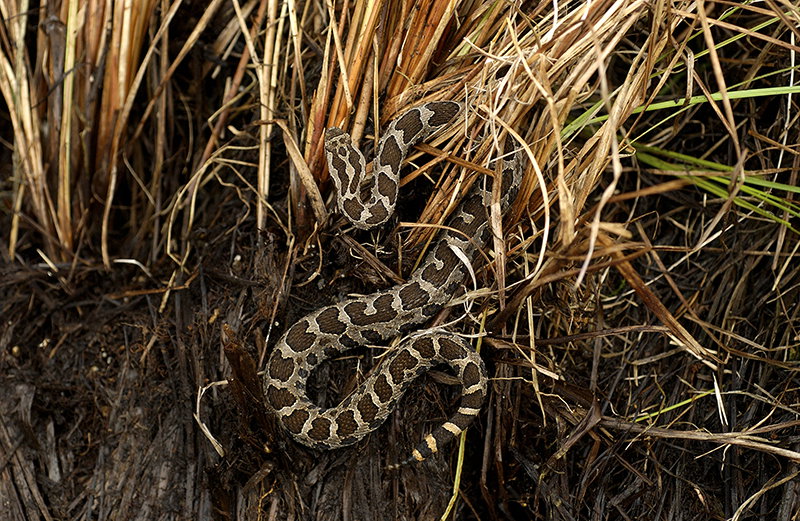
Michigan’s only venomous snake — the eastern massasauga — is on the smaller side. In fact, there’s a good chance you’ll go a lifetime without seeing one in the wild.
The snake is known for its timid predisposition and its equally unintimidating rattle, often likened to a bee’s buzz. It favors wetlands, and the word “massasauga” literally means “great river mouth” in the Ojibwe language.
Under the Endangered Species Act, state and federal authorities classify the eastern massasauga as a threatened species.
Today, Michigan is considered the snake’s “last stronghold” in the United States. But researchers believe that the eastern massasauga was common here and throughout the Midwest before the mid-1970s. Its range spanned neighboring states like Indiana, Illinois, and Ohio, all the way to Wisconsin, Iowa, Minnesota, Missouri, Pennsylvania, New York, and over the border in Ontario.
For years, herpetologists have been working to determine how to protect the snake from extinction. One such herpetologist is Jeff Jundt, the Detroit Zoo’s curator of reptiles. He first got involved with the Species Survival Plan for the eastern massasauga in 2009, the same year the Association of Zoos and Aquariums established it.
Since then, the program has grown to involve the collaboration of several state DNRs, multiple universities, and Canadian researchers. In 2025, the Species Survival Plan became SAFE Eastern Massasauga Rattlesnake. (SAFE stands for “saving animals from extinction.”)
SAFE members conduct research on the snakes at nine sites, including a property in Cassopolis, a village in southwest Michigan.
The study has provided a clearer picture of the species, including its reproductive habits, longevity, and hibernation schedule.
Researchers are also learning more about what’s driving the eastern massasauga’s population to dwindle. Jundt says the main issue “is not necessarily habitat destruction but changes in the habitat.” He elaborates, “A lot of the wetlands used to have a lot of interconnectivities within watersheds and basins. Agriculture and things like that have broken all of that up.”
Due to the loss of connectivity, populations have become more isolated, thus greatly reducing genetic diversity. This leads to inbreeding, causing females to have fewer offspring and even stillbirths.
Researchers hope to resolve this issue by introducing new snakes to affected populations for mating. Currently, conservationists in Windsor and Ohio are attempting this strategy.
“We’re all kind of waiting to see how that is working,” Jundt says.
Success would be significant. Jundt notes that eastern massasaugas have proven extremely difficult to breed under human care. Their habitat requirements also pose a challenge: The snakes need a spot to hibernate and have strong site fidelity (meaning they frequently return to the same place over time).
One may wonder — is a venomous snake species worth preserving? Jundt is quick to point out the ways they protect humans. For instance, their diet includes rodents and ticks, both of which carry harmful diseases.
On the subject of ticks: Lyme disease cases in Michigan have quadrupled since 2022, leading the CDC to classify the state as a “high-incidence jurisdiction” for the first time this year. Additionally, the recently introduced lone star tick — a species now estimated to make up 5% of Michigan ticks — is known to carry Alpha-gal syndrome, which causes a serious allergy to red meat.
“Just one snake each year is taking out hundreds, maybe even close to 1,000, ticks that they’re just ingesting,” Jundt says. “There’s definitely a lot of reasons to keep them around.”
This story originally appeared in the October 2026 issue of Hour Detroit magazine. To read more, pick up a copy of Hour Detroit at a local retail outlet. Click here to get our digital edition.
|
|
|
|
|
|