When I call up Tiff Massey in early November 2025, she’s just returned from Art Basel week in Paris. There, she was exhibiting at France’s largest contemporary art museum, Palais de Tokyo, with other local artists sponsored by the Detroit Salon initiative.
Now home in Detroit, she occasionally pauses our interview to gently shush her dogs, whose names are Cash and Money. “Great experience in Paris,” Massey tells me. “Totally thinking about going back. I want to have a solo show at that space so I can take it over.”
Her first exhibition in France was in 2015, when she was part of a group of Detroit artists at the Lille 3000 triennial. Two years later, her work was shown at the Biennale Internationale Design Saint-Étienne.
Back in the States, her works adorn the walls of Fortune 500 offices: Meta Headquarters in Menlo Park, California, and the Ford Experience Center in Dearborn. And then there are the private collections of billionaires (namely Jennifer Gilbert’s collection, on display at The Shepherd through Jan. 10).
She also has permanent installations at New York City’s Museum of Arts and Design and Australia’s National Gallery of Victoria.
At the time of our interview, she’s working on a commission for the Charlotte Mecklenburg Main Library in North Carolina. She’s also preparing a Belle Isle-inspired sculptural installation for a December art fair in Miami.
Things have yet to slow down for the 43-year-old metalsmith and interdisciplinary artist. She’s known for her statue-size jewelry pieces, centered on Black identity and imbued with her perspective as a proud born-and-raised Detroiter.
While she’s been respected internationally for some time, her crowning moment at home was 7 Mile + Livernois at the Detroit Institute of Arts, which wrapped up its one-year run last May.
When she first got the call to do it, Massey says, “I didn’t necessarily know what I wanted to say, but I knew it was a call to Blackness. … I wanted to give it my all and reflect not only Detroit but where I came from.”
The eponymous intersection near where Massey grew up is the site of Detroit’s historic Avenue of Fashion. After the 1967 rebellion and subsequent “white flight” of residents and businesses, the area was largely reclaimed by Black Detroiters as a central commercial district.
Today, it’s home to the city’s highest concentration of Black-owned retailers — jewelers, hair and nail salons, clothing stores, and restaurants.
While she’s been clear in interviews that 7 Mile + Livernois isn’t so much about the specific place, her memories there, particularly from the ’80s and ’90s, helped inform the messaging behind it.
“These are my first early experiences, observing the fashion of Black opulence,” she says. “Anybody moving to Detroit, I don’t know if y’all ever will experience what that vibe was at that time, so it was important for me.”
Among the works on display was her heaviest to date: Whatupdoe (2024), a 15,000-pound metal necklace. Its scale symbolized the wealth of communal bonds over individual status.
Another, I’ve Got Bundles and I Got Flewed Out (Green) (2023), she created with Mo Alade, a previous collaborator and her longtime personal hairstylist. The canvas featured over 50 unique braids made from green synthetic hair, highlighting the artistry of Black hair salons.

As the youngest solo exhibitor in the museum’s 140-year history, she drew one of the largest DIA crowds in recent memory. Roughly 220,000 people attended the exhibit; about 10,000 were at the closing party alone.
At that final celebration, Massey says, “I broke down once I saw everybody in line. I have a lot of love and respect in Detroit, and it came back tenfold.”
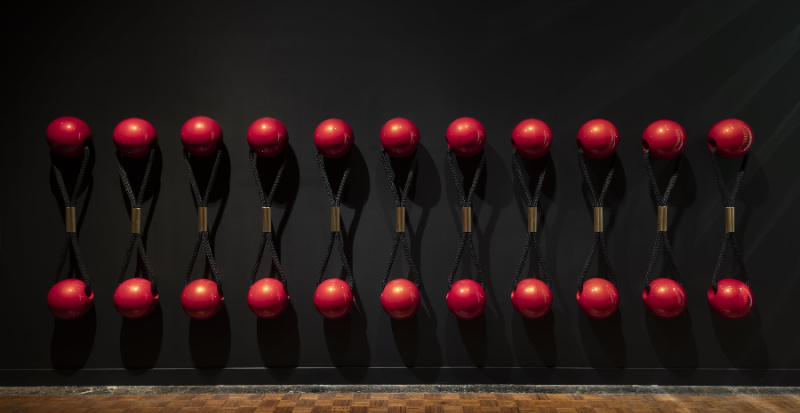
Then, in July, the DIA announced it was acquiring one of Massey’s works from the exhibition — Baby Bling (2023) — for its permanent collection. The striking piece is a giant depiction of “bobos,” hair ties with plastic beads at either end, a ubiquitous headpiece for Black girls and toddlers.
Massey created it in response to a piece in the DIA’s collection, Untitled (1969) by Donald Judd. According to the exhibition’s booklet, Baby Bling nods to “the often-unseen work of Black women, and the care passed down across generations through the braiding of hair.” In 2026, it will be on display in the museum’s new Modern and Contemporary section, which is still under construction.
“I’m happy that one of my children is going to be on view at the DIA permanently,” she says. “It’s just like, how can I build this permanently in the community?”
In 2020, she set out to do just that, closing on a building south of the Marygrove Conservancy, not far from her neighborhood. Her plans were ambitious. The structure had 44 rooms; she envisioned turning it into a space for 44 artists to practice. But after the COVID-19 pandemic struck, her plans changed.
“Now, I’m thinking about how this space can attract people who don’t necessarily know anything about the arts, where they can get some exposure,” she says.
Massey was the first Black woman to graduate from the Cranbrook Academy of Art’s metalsmithing program — and, at the time, the only Black woman taking classes on campus.
She taught art for a time at Macomb Community College and her alma mater, Eastern Michigan University. (She got her bachelor’s there in biology — she originally wanted to be a veterinarian.)
But now, she refuses to teach again, she says, “until I build my own institution.” The facility she envisions would remove the barriers to entry that prevent students from pursuing art.
“You usually have to register for a class via an institution just to get any access to tools or studios or people who can teach you if you have an interest,” she says. “Education is important. And also food. You can’t teach people if they’re hungry.”
What advice does Massey give young artists?
“You need to go out and talk to people. It’s a lot of artists that don’t want to talk or don’t want to deal with the money aspect,” she says. “And you can’t go off what other artists are doing. You have to work as if nobody is looking. You just really got to believe in yourself.”
And she has words of encouragement for young Detroiters: “Regardless of if I’m a fan of them personally, everybody is particularly talented in Detroit. Everybody’s dope as f—.”
This story originally appeared in the January 2026 issue of Hour Detroit magazine. To read more, pick up a copy of Hour Detroit at a local retail outlet. Click here to get our digital edition.
|
|
|
|
|
|