On a sunny afternoon in June, I drive to the Henry Ford Museum of American Innovation — a place I love to explore but admittedly haven’t visited in a few years — for a private tour of an important new exhibit: Fabric of America: Our Fashions, Textiles, and Technologies.
My tour guide is Marc Greuther, the museum’s vice president of historical resources and chief curator. Branding and identity specialist Jeff Newsom joins us, along with Meredith Long, former director of collections operations under Greuther.
As we traverse the museum’s immense footprint, I struggle to contain the urge to explore the various exhibits we pass while Greuther explains how the historical resources department takes care of all the collections, from curation and collections management to conservation and registration.
“We get to work with really interesting collections, and we get to grow them and reinterpret them,” Newsom says. “Sometimes, like today, you’ll see what happens when we get to exhibit them in new ways.”
We arrive at our destination. The newly opened exhibit beckons. Immediately in front of us is a delightful mix of tapestries, clothing, furniture, and equipment. The limited-run exhibit (which ends Sept. 13) is part of the museum’s America: 250 Years in the Making commemoration, with items grouped into categories representing five American values: liberty, practicality, inventiveness, abundance, and individualism.
“We were very keen on tapping into the fashion and clothing collections,” Greuther notes. “We’ve acquired an awful lot of material in the last 10 years or so. Fashion and fabric are as good as any subject area or medium as a way of looking at and thinking about American history.”
He leads us to a pristinely preserved patriotic dress made in 1900 that was used in a parade. “What’s startling about this is it’s quite obviously an old dress, but that kind of approach to using the flag as a means of embellishment feels rather modern,” he says.
The exhibit is packed from floor to ceiling, yet it’s thoughtfully arranged for an easy flow.
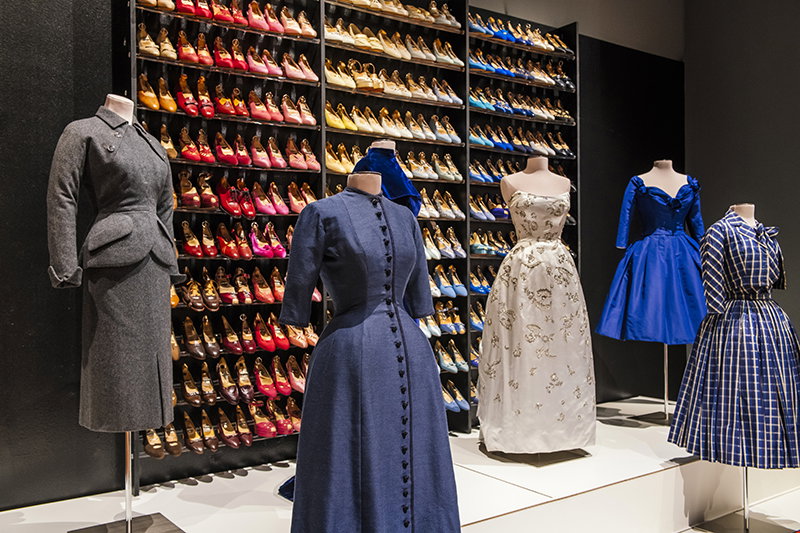
With more than 700 artifacts, the exhibit makes it easy to linger. I revisit multiple displays, especially the graphic, colorful tapestries that Alexander Girard designed for Herman Miller and a selection of Elizabeth Parke Firestone’s shoes and haute couture dresses — including designs by Dior, Balenciaga, and Yves Saint Laurent. Other items that caught my eye were a wedding dress made from a parachute during World War II (silk had been requisitioned for the war effort), a Nixon campaign dress, and Devo’s Tyvek suits.

A grouping of dresses created by American fashion designers is a big draw. The section features pieces from Newsom’s collection, the most recognizable of which is a Donna Karan cold-shoulder dress that Hillary Clinton wore in 1993.
“Jeff’s been very generous with materials he’s collected over the years, so we’ve been building up a nice portfolio,” Greuther says.
To date, Newsom has donated nearly 100 artifacts to the museum. “Some people collect Tupperware,” he jokes.
Fabrics, clothing, machinery, technology, people, places, and moments in time. The Fabric of America exhibit is a kaleidoscopic journey of the essence of America — one of many compelling reasons to visit this treasure of a museum that we are so lucky to have in our own backyard.
The exhibit runs through Sept. 13 at the Henry Ford Museum of American Innovation. It’s free for members or with museum admission.


|
|
|
|
|
|