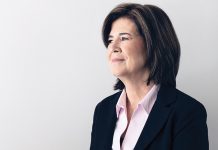
In a room bustling with conversations and reunions, Leseliey Welch fixes her bobby pin on her brazen amber dreadlocks. The CEO of Birth Center Equity, a national nonprofit growing access to community-based birth centers, and co-founder of Birth Detroit, the city’s first and only freestanding community birth center, isn’t just checking her crown; she’s centering herself before a room full of maternal health decision-makers.
It’s November 2025, and in her hands lies a copy of the keynote she’s about to deliver to the American Association of Birth Centers’ Birth Institute, the organization’s annual conference for birth-center professionals. Her speech largely centers on the new “Beloved
Birth 50 by 50” initiative, an ambitious vision to ensure that by 2050, half of the babies in the U.S. are born into the care of midwives.
For Welch, this isn’t just another speech; it’s an answer that directly addresses one of Detroit’s most devastating maternal health statistics: In the March of Dimes’ annual report card, released in November 2025, the city had the highest preterm birth rate among the 100 U.S. cities with the most births, with 16.6% of babies born before 37 weeks of gestation. That means that roughly 1 in 6 babies born in the city are preemies — Detroit’s preterm birth rate is 50% higher than the state average and the highest among major U.S. cities like Chicago, Miami, and New York.
As she prepares to step toward the podium, the weight of this fact feels especially heavy. “Now is the time to state clearly what we are for. … We don’t have to agree on all things to agree on this one thing,” says Welch in her keynote. “As a Black mama, I believe that every baby is my baby, and it steers my soul to hear the experiences of joy and grief in childbirth.
“Personally, I’ve experienced a late-term pregnancy loss,” she continues. “I was with my brother when my nephew was born and died on the same day in a local Detroit hospital. We are the statistics that we talk about, and that guides this work.”

Birth Center Equity invests close to $10 million to strengthen 40 community birth centers serving 58 U.S. communities, expanding culturally centered maternal care nationwide. Birth Detroit sits in the heart of the Petoskey-Otsego neighborhood and launched services in its own building in January 2025 — previously providing midwifery-led care through Brilliant Detroit during the pandemic in 2020. The organization’s impact has supported more than 400 families, with plans to serve 500 families annually moving forward.
“Detroit’s persistently high infant mortality rates, particularly for Black babies, aren’t about individual choices or behaviors — they’re about structural inequities and the intergenerational trauma of systemic racism,” Welch says. “Black families in Detroit face severely limited access to safe, culturally reverent care, and when they do access the health care system, they often encounter bias and discrimination that directly impacts outcomes.”
The Statistics on Mortality in Detroit
Infant mortality is defined as the death of a live-born infant before their first birthday. While Michigan as a whole has seen infant mortality rates decline, the rates in Detroit remain alarmingly high compared to national averages. But why?
Dr. Mona Hanna, founder of Rx Kids, the nation’s first community-wide prenatal and infant cash prescription program, which began in Flint and expanded to Detroit in February, sheds some light on the subject. “Detroit’s infant mortality problem is driven heavily by prematurity and low birth weight, which are both tightly linked to poverty and material hardship,” says the associate dean of public health at the Michigan State University College of Human Medicine.
“The systemic and compounded adversity of living in disadvantaged places means that families are forced to navigate pregnancy and newborn care under stacked structural risks,” says Dr. Hanna, who was included in Time magazine’s list of the “100 Most Influential People in the World” in 2016 for her role in exposing the Flint water crisis.

“There are many reasons here: care access, disparities, transportation, racism, food deserts, and the list goes on and on,” says Dr. Hanna.
Rx Kids cuts through red tape and provides direct cash support to pregnant mothers and newborns — and has already delivered over $20 million to more than 5,000 families across nearly 30 communities statewide. Since its launch in Flint in 2024, the program has given $1,500 during pregnancy and $500 per month during a baby’s first six to 12 months.
The Policymakers
The machinery of the state is also pivoting. Dawn Shanafelt, director of the Division of Maternal and Infant Health at MDHHS, has been at the forefront of one of the state’s most significant answers: the Michigan Doula Initiative. A doula is a trained professional who supports the person giving birth — not the medical procedure. The state now has more than 1,000 registered doulas. But despite evidence of improved outcomes, fewer than 10% of U.S. births involve a doula.
Launched in 2023, Michigan’s doula program allows Medicaid to cover doula services, a major shift that was aggressively expanded through 2025. Now the program allows for Medicaid reimbursement of up to $2,700 per birthing parent, covering 12 visits and labor support.
“Access is the biggest thing,” says Shanafelt. “What’s different now than the work we were doing before is that we’re actually listening to the families and extended families, and that has been a huge dynamic shift. After birth, the relationship between a doula and a new mother results in less birth trauma and fewer birth complications. Doulas complement the birth and advocate for the mothers. Having a birth professional by your side shifts the results significantly.”
Shanafelt’s data suggests that the initiative is doing more than just providing comfort; it’s acting as a bridge. Families enrolled in the state’s Maternal Infant Health Program are reportedly 44% less likely to report food insecurity and significantly more likely to attend checkups postpartum — a critical window in which many maternal and infant complications arise.

The Postpartum Doula
But what does this policy look like in a living room in metropolitan Detroit? Lynn Eads, a practicing postpartum doula who, through her maternal support and education business Learn with Lynne, offers services such as postpartum doula care and pediatric sleep consulting, sees the statistics as faces. To her, a postpartum doula is the “grounding” that the traditional medical system often lacks the time to provide.
“Every mom deserves to be cared for after giving birth by a certified postpartum doula,” she says. “We weren’t meant to do motherhood alone. Giving birth — and adopting — is the biggest identity shift a woman goes through. Certified postpartum doulas provide evidence-based guidance and care that ranges from breastfeeding, recovery, and nutrition to safe sleep practices in real time. … When moms have support during postpartum recovery … they have the benefit of a trained professional watching out for warning signs and early detection of potentially serious post-birth complications.”
Research backs Eads’s lived experience. A 2025 study published in the American Journal of Obstetrics & Gynecology adds powerful, up-to-date data showing associations between doula care (including postpartum doulas) and improved maternal and newborn outcomes. Mothers experienced fewer preterm births, improved postpartum follow-up, and higher rates of exclusive breastfeeding.
“As a caring, loving, empathetic doula, I’m passionate about this piece of support,” says Eads. “I always provide a nurturing, observant, trained eye over the mom and check in with both parents at each visit to find out how things are going, how they are feeling, and make those assessments that could potentially make a difference between life or death.”

A Shared Impact
From the opening of Birth Detroit’s new midwifery services to the expansion of state-funding support, the goal is no longer just “lowering infant mortality rates.” It’s ensuring that every Detroit baby doesn’t just survive their first year but enters a world that is ready for them.
|
|
|
|
|
|