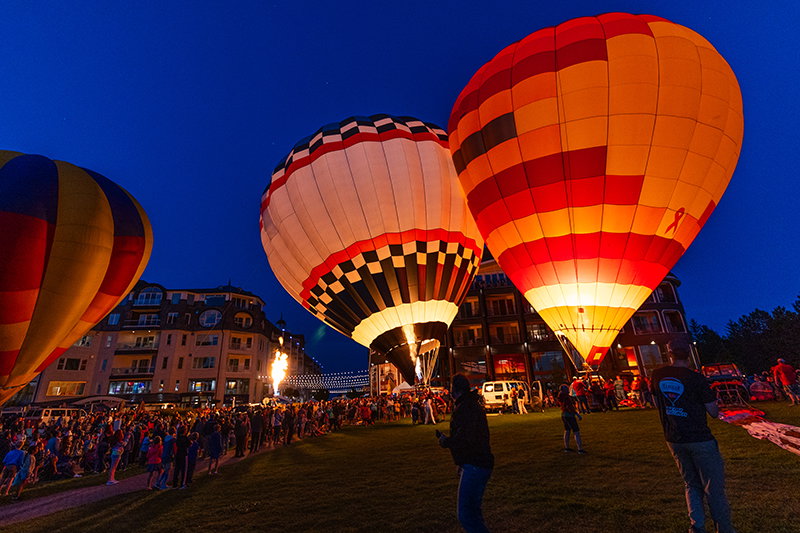
In mid-September, northern Michigan already feels autumnal. It’s the first day of Balloons Over Bay Harbor, an annual festival that takes place in Bay Harbor near Petoskey. As a member of the media, I’m one of the lucky few who’s been offered the opportunity to take a flight that departs from the village, goes over Little Traverse Bay, and lands in Harbor Springs.
Early in the morning when it’s still dark out, we meet with the pilots in a conference room across from our hotel. They determine that wind conditions are less than ideal for flying this morning.
With a free window, my travel companion and I stroll down a dock, reading the backs of private vessels. Some are local, some hail from faraway places like Montana, Florida, and Texas. They have names like Nessie Lou, Miss B Haven, and Toxic Asset.
We’re at the Bay Harbor Marina. Before 1995, there was no Bay Harbor. The 90-acre inlet that feeds into Little Traverse Bay is completely manmade, a channel carved out of limestone.
Today, a quasi-downtown with luxury lodging, shops, galleries, restaurants, and a theater face the waterfront. The drastic redevelopment began under real estate magnate David V. Johnson in partnership with William McCormick Jr.
Johnson, who’s been the sole owner since 2002, also owns Oil Nut Bay in the Virgin Islands. And in Michigan, he owns a large chunk of South Fox Island in Leelanau County.
Dinner and…
On Thursday evening, my travel companion and I make our way to a restaurant called NOMAD. We pass shops and walk under a metal arch that says, “South Fox Island.”
We’re coming from Village Suites Bay Harbor, where we’ve just arrived and settled into our lovely room with a view of the water.
The restaurant is bustling with tourists in town for the festival. We find our table, where our hosts from the Petoskey Area Visitors Bureau are waiting for us. We learn a bit about the history of Bay Harbor.
Previously in its place was an abandoned industrial zone, which ran five miles along the shoreline. Between the 1920s and 1980s, a factory heated limestone that workers mined from the surrounding 1,200 acres or so of quarries, to make concrete.
Smoke once billowed from a towering chimney near the edge of the water. By the time the Penn-Dixie Corporation acquired the plant in 1954, it produced upwards of 1.6 million barrels of concrete a year. Most of the concrete required to construct the Mackinac Bridge, 420,000 barrels, came from this site.
Dinner at NOMAD ends up being one of my favorite dinners of the trip. I try a sample from everybody’s plate.
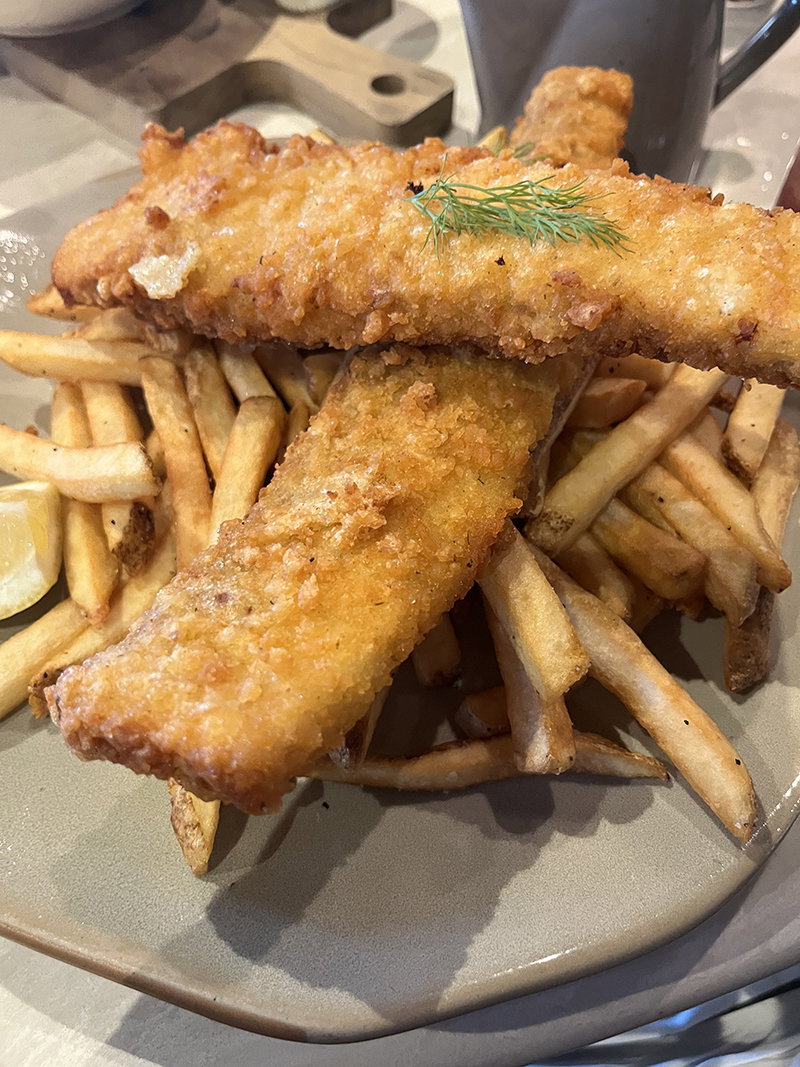
The rigatoni is a decadent, basil-forward meat lover’s supreme: wagyu beef, Italian sausage, and chorizo with grated pecorino. The fish and chips are made with Michigan walleye encrusted with salt and vinegar and served with a house-made horseradish cream. But the steak takes the cake: a juicy New York Strip cooked perfectly to medium rare, enhanced with salt, pepper, rosemary, roasted garlic, and a gorgonzola crust.
…a Show
With little time to spare after dessert, we hurry over to Great Lakes Center for the Arts and take our seats. The theater is packed for this production of Come from Away, a Broadway musical based on the true events following the 9/11 attacks. Thirty-eight airplanes were diverted to Gander, Newfoundland; where the townspeople band together to feed and house the 7,000 or so stranded passengers. The theater timed the production to commemorate the 25th anniversary of September 11.
It’s an impressive production. And as Artistic Director Matthew Kacergis tells it, the casting process was quite comprehensive. They sorted through 3,200 submissions and auditioned 300 actors for its cast of 12 (plus three understudies).
There were a number of behind-the-scenes touches that helped give the production a “Broadway feel.” For instance, the center hired Joel Goldes, the original dialect coach from the Broadway production, to help the cast nail the region’s unique accent. (I’ll admit, saying “oym an oylander” became a recurring bit throughout the trip for my travel companion and I, until it got really annoying).
Great Lakes Center for the Arts was made possible through many partnerships. It opened in 2018 on land donated by Bay Harbor Co. During production, actors stay at the nearby Bay View Inn, another partner. In its eight years of operation — with shows year-round — it has become quite a draw for locals and tourists alike.
“My first favorite piece of feedback is ‘I loved the show,’” says Kacergis. “My second favorite piece of feedback is ‘That wasn’t really for me, but it was a great experience, and it was so well-done that we’ll come try the next one.’”
In addition to theatrical productions, the Great Lakes Center for the Arts hosts music concerts — a recent favorite was Lyle Lovett — and screens films.
Pointer Boat Tour
In Harbor Springs, Harbor Point is a long, narrow peninsula that juts out into Little Traverse Bay. It’s populated with about eighty waterfront homes. I hesitate to call them cottages. Each one is its own Rockwellian palace, with Victorian-style towers, sprawling balconies, well-manicured lawns, and facades of many colors, all accented with spotless white paint that gleams like snow in the summer sun.
For the most part, nobody lives here year-round. And as our guide on the Pointer Boat tour tells us, these homes rarely go on the market. That’s because, for over a century, most have stayed within the same families. Among them are the Fords, Dodges, Fruehaufs, Bissels (as in, the vacuum), the Gambles (as in Proctor and Gamble), and the Offield family (descendants of the Wrigley’s gum empire founder).
In a fashion similar to Mackinac Island, the Harbor Point homeowner’s association forbids cars between July 1 and Labor Day, permitting only horses and horse-drawn vehicles.
At its very tip is a lighthouse called Little Traverse Light. Unless you’re a Harbor Point resident, the only way to view it is from the water. Built in 1884, its first keeper was a woman named Elizabeth Whitney.
After the tour, my companion and I share six oysters and some sandwiches on the dock at The Pier restaurant. Across from us, parked at the Boathouse of Harbor Springs next door, is a massive yacht called Delta Victor. “Whose boat is that?” asks a woman at the table next to us. “It’s owned by the DeVos family,” says our server.
Flying Over the Bay
After we’ve returned from Harbor Springs, I get a call: if we hurry, there’s a chance we can take a balloon flight.
Our pilot is Chuck Walz. He may be the youngest looking 70-year-old I’ve ever met. But I suppose when you have a job as cool as his, it must keep you young. As a professional balloonist, Chuck has done over 1,500 hours in the air, and flown in nearly every state in the U.S.
Tonight is his 50th anniversary with his wife, Cindy. He calls her “dearie” over the radio during our flight. The two have been in the ballooning business together over 35 years. And he makes it a point to check that I’m mentioning Cindy in the article. “I could not do this sport without her,” he says.
My travel companion and I wait outside his truck. All the pilots are standing by for a final assessment of conditions. The whole town of Bay Harbor has gathered on the lawn to watch.
With a helium tank, Chuck inflates a “pibal,” short for “pilot ball”— a small balloon used to check wind speed and direction. He lets it fly, and we watch it drift up and over all the buildings, shrinking into a smaller and smaller black dot as it travels northward.
There’s a lot of waiting around. Then, in an instant, the announcer declares that flight conditions are safe. Chuck waves us over. His crew uses a fan to begin filling the balloon. After it’s inflated — with the burner doing the rest of the job — we enter the basket.
The quarters feel pretty close. It’s the three of us, a propane tank, and not much else. The basket is wicker and made from rattan, a type of climbing palm. According to Chuck, this material is preferred for its flexibility. This can help to absorb some of the inertia from the landing; particularly when the balloon is coming in at 10 to 15 M.P.H., known as a “sporty landing.”
Chuck fires the blast valve, and we begin our ascent. Immediately in front of us is another partially inflated balloon, which we begin to collide with.
“Pat the material, pat the material!” he yells over the flame’s roar.
With my left hand holding tight to the grip, I extend my right to push the colorful fabric away from the basket so it doesn’t snag. We continue to climb higher and higher, to a height where the wind will carry us along the desired flight path.
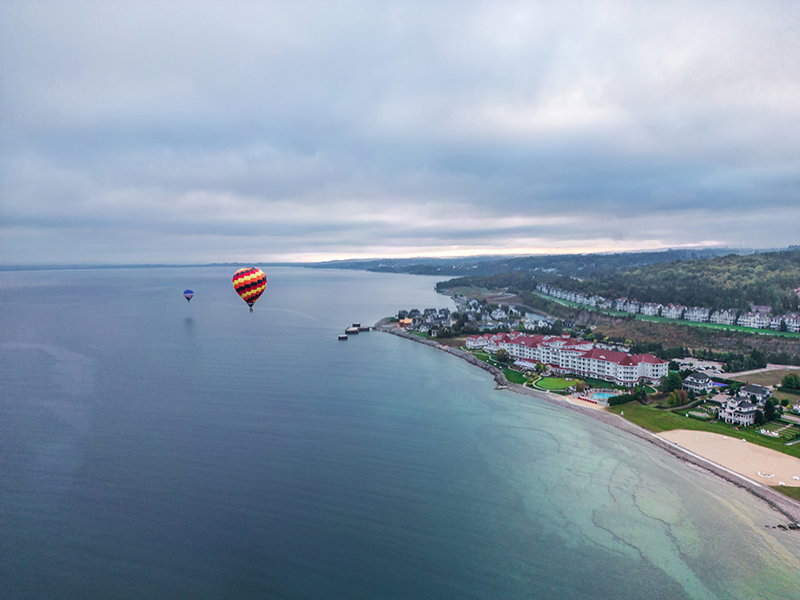
Once we’re up, it’s beautiful, calm, and incredibly quiet (minus the occasional blast from the burner). The town looks like an elaborate miniature train set as we glide over the rolling hills and the red roof of the Inn at Bay Harbor.
Now that we’ve reached the water, I look back and see a parade of balloons behind us. I’m reminded of the term pilots use, “gentle giants,” which I first heard from Derrick Jones, Event Director for West Michigan Balloon Events.
“Over the bay is definitely a magical flight,” he tells me. “We don’t have the opportunity to have that flight path like we do up here in Bay Harbor.” This is his seventh year directing the event.
Ahead of us is a younger pilot, who keeps dipping down incredibly close to the water. “We all want to get our feet wet in Lake Michigan,” says Chuck.
A Soft Landing
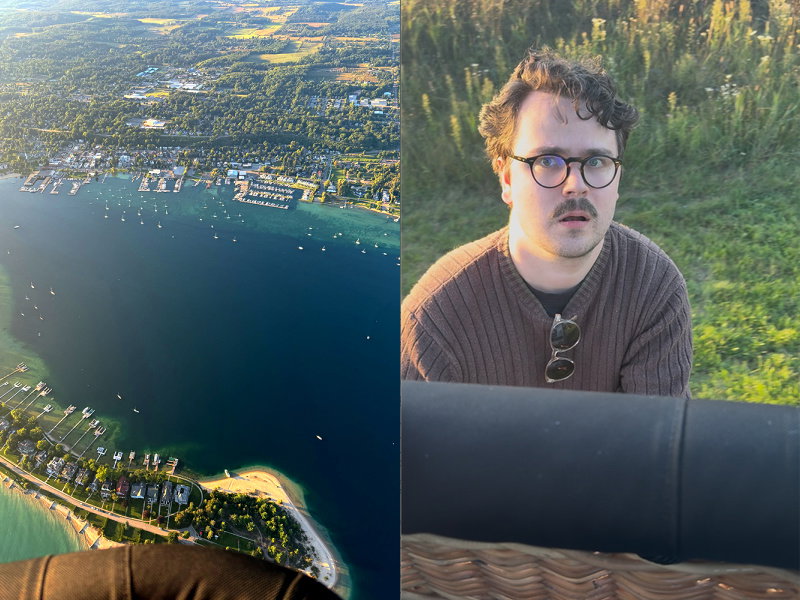
As we approach the other side, we see Harbor Point, and countless boats anchored near the shore. We see the Harbor Springs High School football field, where the varsity team, the Rams, is playing the Frankfort Panthers. We begin our decent over a golf course but blow slightly past it into a field near a neighborhood.
The basket collides with the top of a pine tree. But I know not to worry, because before the flight Chuck told us, “If I hit a tree, I did it on purpose. It’s going to help me slow down.”
Finally, we land in someone’s backyard. The crewmembers are parked on the street and waiting for us. They attempt to make contact with the owner via the Ring camera but nobody’s there. Two dogs come out to greet them.
Chuck asks me to get out and help guide the balloon to the nearby road. I do my best. We walk it through an overgrown field. My travel companion remains on the balloon and wipes a tick off of me.
With the help of some neighbors, we roll the balloon into a long cigarette shape. Then, we fold it over itself into little strapped increments, into a big bag, and into the truck bed.
The Afterglow
On Saturday, the final day of our excursion, my travel companion and I relax in the Village Suites’ hot tub. It’s conveniently close to the lawn where the balloon glow is happening. The pilots let off their flames in sync with the trumpet part from Neil Diamond’s “Sweet Caroline.” As we watch, I think back through all the places we visited during the trip. Here are a few of my previously unmentioned favorites:
Breakfast at Sam’s Graces Café in Petoskey
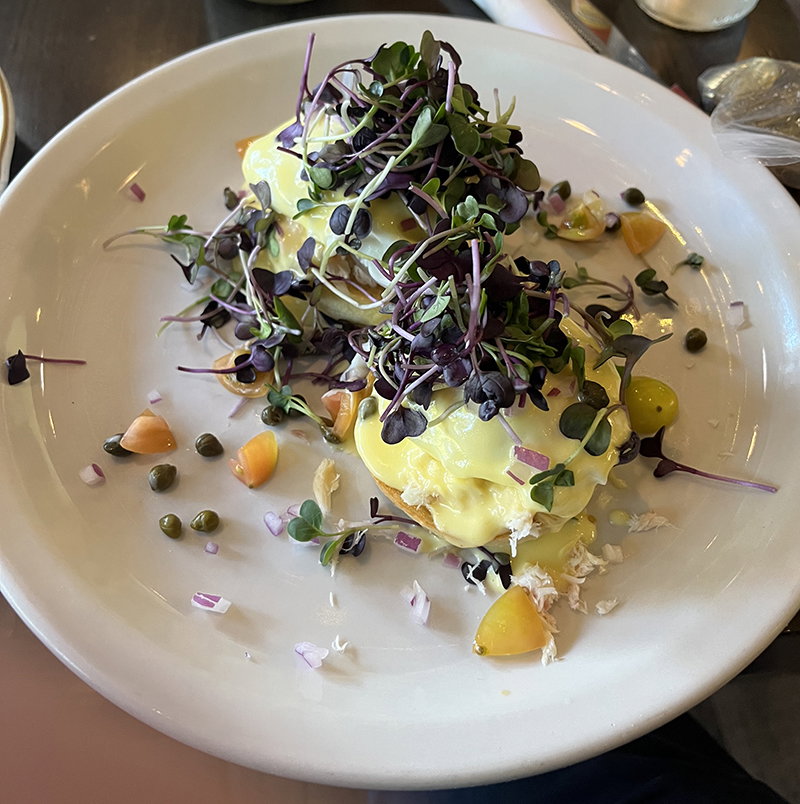
This unassuming café makes an incredible breakfast. Their eggs benedicts incorporate ham and whitefish from Plath’s, a historic meat smoker located just down the street. The restaurant shows an incredible commitment to making everything from scratch: the English muffins for the benedicts and even condiments, like ketchup and jelly.
Skybridge Michigan
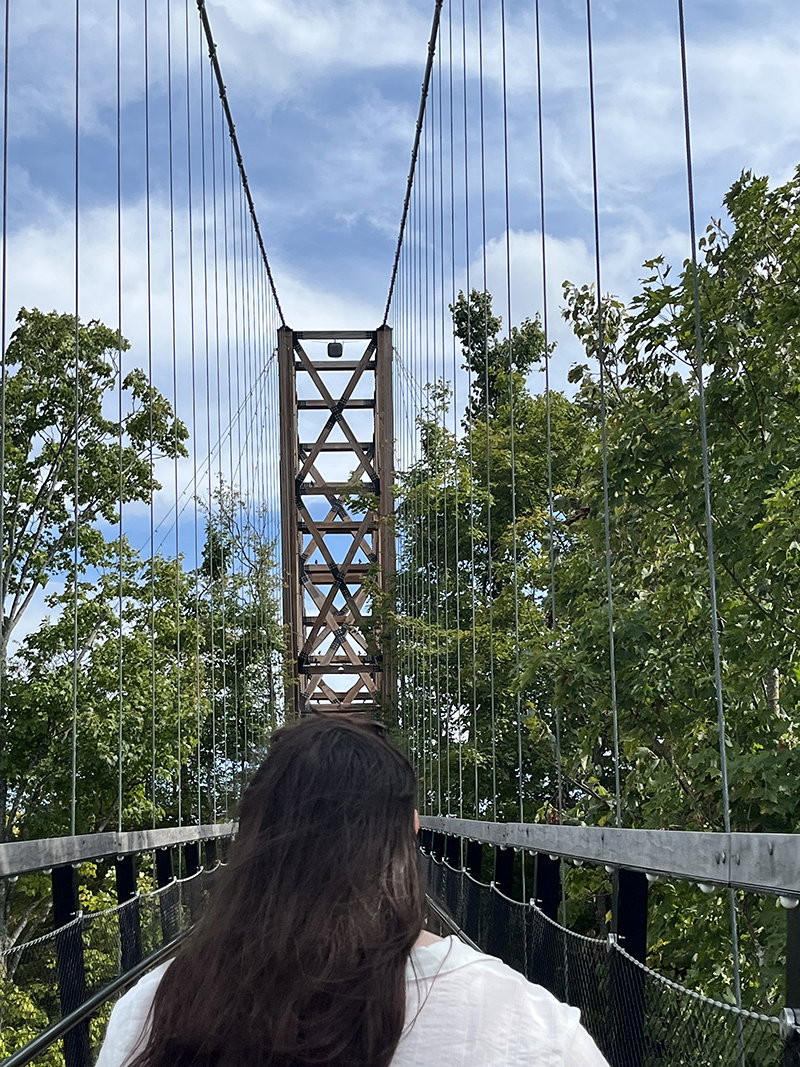
It’s not just a way to get people to come to Boyne Mountain when it’s not snowy. The Skybridge is a genuinely incredible view of the area’s picturesque forests and terrain. It made for an excellent afternoon excursion. It’s a popular proposal spot for a reason. In fact, I stopped to tie my shoe and the group behind us thought I was proposing to my travel companion.
Harbor Springs’ Museums
For history buffs, Harbor Springs has three museums, all located conveniently close together on Main Street.
At the Harbor Springs History Museum, we learned about the region’s storied past as a logging community and its transition to tourist town.
The Andrew J. Blackbird Museum is dedicated to Indigenous history and culture. It is located in the former home of the late Andrew J. Blackbird, a notable figure in the local Odawa community. Inside, local artist Jacob Keshick taught us about the history of porcupine quill boxes.
The Ephraim Shay Works Museum is dedicated to Ephraim Shay, an inventor and logger from Harbor Springs whose design popularized the geared steam locomotive.
|
|
|
|
|
|